

Quick answers (30-second read)
- What it is: Nymphaea caerulea — an ancient Egyptian water lily with 3,000+ years of documented use. Not a true lotus.
- Is it legal in Germany? Yes — not listed under BtMG or NpSG. Free to buy, possess, and consume.
- What does it do? Users report mild relaxation, dream-like states, subtle mood lift. Not psychedelic.
- Active compounds: Nuciferine (calming) and apomorphine (dopamine-active) — in low concentrations.
- Most common forms: Dried flowers for tea, wine infusion, tincture, or vaporized extract.
- Avoid if: pregnant, breastfeeding, taking MAOIs or SSRIs, or operating vehicles.
What Is Blue Lotus?
The blue lotus flower (Nymphaea caerulea), also known as the blue Egyptian lotus or sacred blue lily, has captured the attention of people worldwide due to its unique properties. Revered in ancient Egyptian culture, it has been used in rituals, medicines, and even art. Today, its psychoactive effects and potential health benefits are gaining renewed interest.
Shop blue lotus at amama: Browse our Blue Lotus collection → — dried flowers, extracts & tinctures, lab-tested with COA.
The blue lotus is a water lily that grows primarily in Egypt and parts of Asia. Historically, it played an essential role in Egyptian culture, symbolizing rebirth and the cycle of the sun. In ancient texts and art, the blue lotus is frequently depicted in scenes of religious significance.
Quick botanical facts
| Latin name | Nymphaea caerulea |
| Family | Nymphaeaceae |
| Origin | Nile Delta, East Africa |
| True lotus? | No — it's a water lily |
| Flowering | Summer |
| Edible parts | Flowers and petals |

Nymphaea caerulea (Blue Egyptian Lotus). Plate from 'Flore des Serres et des Jardins de l'Europe', edited by Louis van Houtte, 1851–52. The blue lotus was sacred in ancient Egypt — depicted in temples, tombs, and papyri from the Old Kingdom through to the Greco-Roman period.
Wikimedia Commons · Public Domain
The Science Behind Blue Lotus
The blue lotus contains two primary compounds responsible for its psychoactive effects:
- Apomorphine — a dopamine agonist that can induce feelings of happiness and euphoria. It's also been studied for its potential role in treating Parkinson's disease and erectile dysfunction.
- Nuciferine — an alkaloid with antipsychotic properties, promoting relaxation and calmness, though its mechanisms aren't yet fully understood.

Nuciferine

Apomorphine
Despite its long history, modern research into these compounds is limited, and their effects on the human body are not yet fully understood. Most available data comes from in-vitro studies and animal models — robust human trials are still rare (Farrell et al., 2016).
Blue Lotus in Ancient Egypt
Historically, the blue lotus flower was a staple in ancient Egyptian ceremonies and remedies. It was often used as a sleep aid and to induce calm, relaxed states. The flower was believed to open pathways to heightened states of consciousness, making it a central figure in religious rites.
“I am the pure lotus which springeth up from the divine splendour that belongeth to the nostrils of Ra.”
— Papyrus of Ani (Book of the Dead, Chapter 81A, c. 1240 BCE)

Fragment from the Tomb of Nebamun, Thebes. Dynasty 18, c. 1350 BC. The pond teems with lotus flowers (Nymphaea caerulea) and birds — a symbol of rebirth and paradise in ancient Egyptian cosmology.
British Museum · Public Domain
Archaeological finds — including depictions from Tutankhamun's tomb — show the plant in ceremonial contexts. Researchers like Emboden (1981) identified Nymphaea caerulea as a significant component of ritual practice in ancient Egyptian and Maya cultures.
Common misconceptions about blue lotus
Blue lotus sits at a busy intersection of botany, pharmacology and Egyptology — and a lot gets garbled along the way. Five quick corrections:
- “It’s a lotus.” → It’s a water lily. Nymphaea caerulea belongs to Nymphaeaceae, the water-lily family. The “true” lotus (Nelumbo nucifera, the Indian sacred lotus) is a different plant in a different family — with different alkaloids and very different pharmacology. The two are regularly confused in both spiritual and commercial writing.
- “Egyptians only used it ornamentally.” → They also ate it. Herodotus describes Egyptians drying the roots, pounding them into flour, and baking them into bread (Histories II.92). Seeds and petals went into food as well as fermented drink.
- “All Egyptian lotuses were native.” → The red lotus was an import. Only Nymphaea caerulea (blue) and Nymphaea lotus (white) are native to Egypt. The red/pink lotus was introduced from India around 500 BCE and joined the ritual palette only later.
- “The Tutankhamun lotus imagery was purely symbolic.” → His mummy was physically covered in blue lotus flowers. Howard Carter’s 1922–23 excavation notes describe a layer of Nymphaea caerulea petals draped directly over the mummy — a material ritual, not just iconography.
- “Blue and white lotus behave the same way.” → They’re on opposite clocks. Nymphaea caerulea opens at dawn and closes by late afternoon, tracking the sun. Nymphaea lotus (the white one) opens at dusk and closes before midday. That daily rhythm is precisely why the blue lotus became the Egyptian symbol of solar rebirth — it was chosen because its cycle matched the sun god’s.

Vignette from the Papyrus of Hunefer (c. 1275 BC, 19th Dynasty). The deceased approaches the Hall of Two Truths, carrying a lotus in his right hand — the flower was the symbol of resurrection and the daily rebirth of the sun god Ra.
British Museum · Public Domain
What Users Report (and What the Research Shows)
“The Egyptians that live near the marshes … gather [the lotus], dry it in the sun, pound the middle of the flower … and bake it as bread.”
— Herodotus, Histories II.92 (c. 440 BCE) — the earliest outsider account of lotus use in Egypt
Health claims surrounding blue lotus are largely anecdotal, with limited modern research to back them up. What users commonly report, and what published studies suggest, diverges in important ways. Here's the honest picture:
1. Sleep support
Blue lotus has been used for centuries to help with restful sleep. Users believe the calming effects of nuciferine help soothe the mind, making it easier to drift into sleep. Clinical trials in humans are lacking — the effect is widely reported but not formally validated.
Nuciferine
2. Calm and relaxation
Many users describe blue lotus as mildly relaxing, with a subtle mood-lifting quality. Apomorphine's dopamine activity and nuciferine's antipsychotic profile may contribute — though specific effects on anxiety in humans have not been established in controlled trials.
3. Antioxidant content
Blue lotus contains flavonoids including quercetin and myricetin. These are well-documented antioxidants — though the plant's overall contribution to dietary antioxidant intake is modest compared to common foods (berries, tea, cocoa).
4. Potential research in Parkinson's (apomorphine specifically)
Apomorphine — one of blue lotus's alkaloids — is used as a licensed medication for advanced Parkinson's disease. This does not mean consuming blue lotus treats Parkinson's. The concentrations in the plant are far below therapeutic doses, and self-treatment is not advisable.
What users don't report
- ❌ Visual distortions or hallucinations
- ❌ Ego dissolution or "trip" experiences
- ❌ Cannabis-like stoned feeling
- ❌ Physical heaviness or loss of control
Blue lotus is consistently described as mild — more like a calm glass of wine than like Cannabis or psychedelics.
How Long Does It Last?
Based on documented user reports on Erowid and Bluelight:
0 min → Consumption (tea or wine)
15–30 min → Mild effects set in
30–60 min → Peak: relaxation, dream-like
60–90 min → Gradual decline
2–3 hours → Return to baseline
Individual response varies based on body weight, metabolism, whether taken on an empty stomach, and product quality.
Downsides and Safety Concerns
1. Lack of research
Despite the potential benefits, there's a significant lack of scientific research backing up the health claims associated with blue lotus. Without large-scale clinical trials, it's difficult to confirm its efficacy or guarantee safety.
2. Psychoactive effects
One of the main considerations with blue lotus is its psychoactive properties. While it is not a hallucinogen, the flower can induce mild euphoria and altered states of consciousness, which may not be suitable for everyone.
3. Interactions with medications
Blue lotus should not be combined with:
| Medication / Substance | Why |
|---|---|
| MAO inhibitors (e.g. moclobemide) | Theoretical risk of serotonergic overstimulation |
| SSRIs / SNRIs | Combined serotonergic activity |
| Neuroleptics | Unpredictable dopamine interaction |
| Sedatives / benzodiazepines | Amplified sedation |
| Alcohol (outside the traditional wine infusion) | Combined CNS depression |
If you're on regular medication, check with a pharmacist before trying blue lotus.
4. Potential for misuse
As with any substance that alters consciousness, there is a potential for misuse. Mixing blue lotus with alcohol or other substances may increase side effects and impair judgment.
5. Pregnancy and breastfeeding
Due to the lack of research on its effects, blue lotus should be avoided by pregnant or breastfeeding individuals.
6. Common side effects (rare, mild)
Occasional user reports include:
- Mild nausea (often from too high a dose or empty stomach)
- Headache (usually dehydration-related)
- Dizziness
- Dry mouth
If symptoms are severe or persistent: consult a doctor. In Germany: emergency medical service 116 117; emergency 112.
How to Use Blue Lotus
There are several ways to prepare blue lotus. Start low, observe effects, and don't combine forms.
1. Tea — the gentlest method
- What you need: 2–5 g dried flowers, 250–400 ml water, a strainer
- Water temperature: 75–80 °C (alkaloids are heat-sensitive; avoid boiling)
- Steep time: 10–15 minutes, covered
- Tip: a splash of lemon helps extraction via mild acidity
- Onset: 20–30 min · Duration: 1–2 hours
2. Wine infusion — the traditional Egyptian method
- What you need: 5–10 g dried flowers, 750 ml dry red wine, sealed glass jar
- Process: steep 24 hours in a cool, dark place; strain
- Onset: 30–60 min · Duration: 2–3 hours
- Warning: alcohol effects add to the lotus effect — go slow
3. Vaporizing (extract)
- What you need: a blue lotus extract (10x or 20x), precision vaporizer
- Temperature: 120–150 °C (never above 180 °C — alkaloids burn)
- Onset: 2–5 min · Duration: 30–60 min
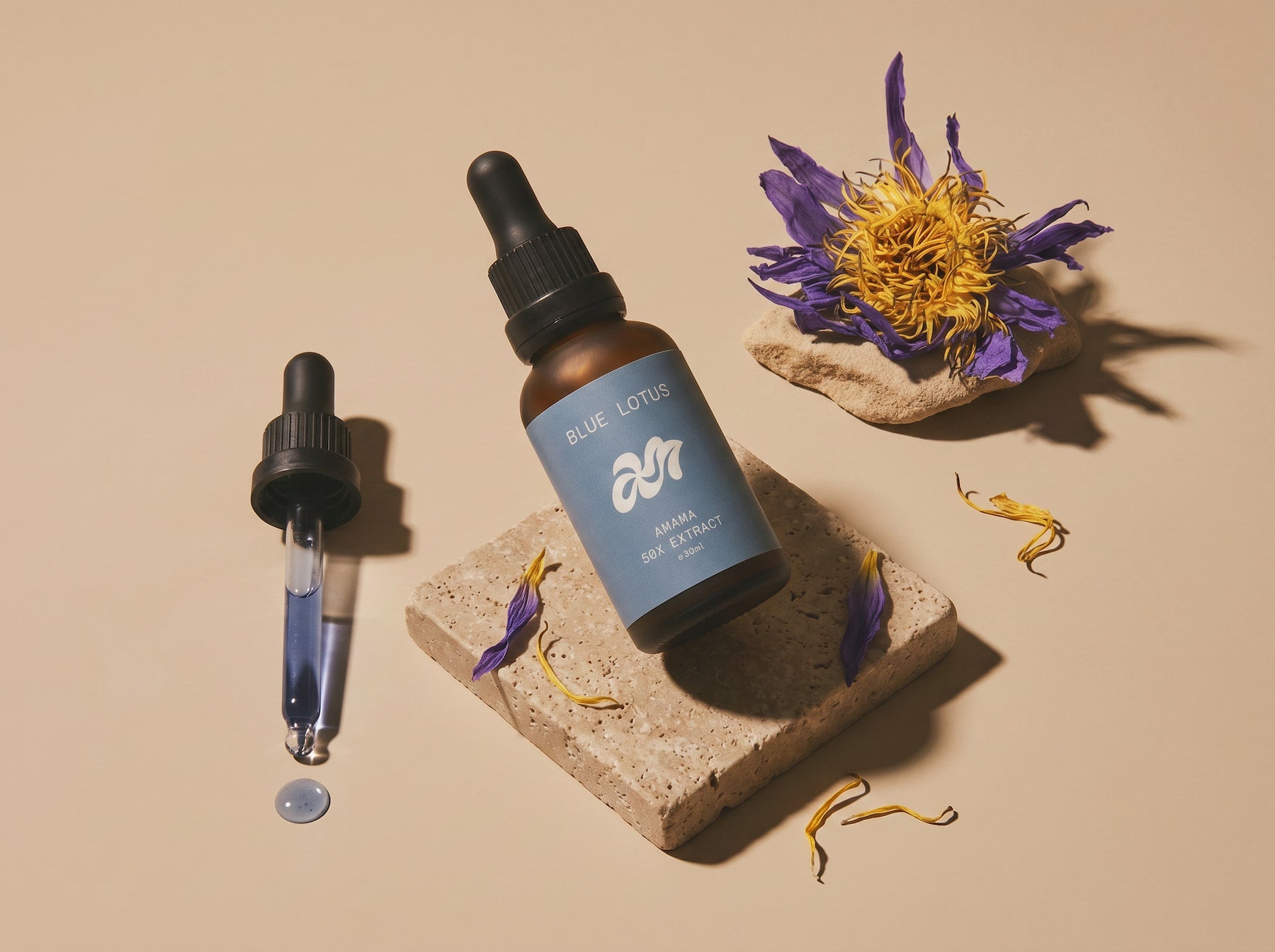
4. Tincture (sublingual)
- Process: 30 g flowers in 250 ml high-proof alcohol, 2–4 weeks; filter into dark dropper bottle
- Typical dose: 20–30 drops sublingually
- Onset: 10–15 min · Duration: 1–2 hours
5. Essential oils (aromatherapy only)
- Use in a diffuser or as massage oil. Not for ingestion.
- Provides light atmospheric effects.
Not recommended
- Smoking dried flowers — direct combustion destroys most alkaloids.
- Combining with Cannabis or other CNS depressants — compounds sedation.
For more detail, see our dedicated spoke: Blue Lotus Preparation Guide.

'Love Potion' Blue Lotus Extract
Is Blue Lotus Legal?
Short answer: yes, in Germany and most of Europe.
Blue lotus (Nymphaea caerulea) is not listed in Germany's Narcotics Act (BtMG) or the New Psychoactive Substances Act (NpSG). Its alkaloids (nuciferine, apomorphine) do not fall under any regulated substance class.
Legal status by country
| Country | Status | Notes |
|---|---|---|
| Germany | Legal | Not in BtMG or NpSG. Sale and consumption freely permitted. |
| Austria | Legal | Unregulated |
| Switzerland | Legal | Not in BetmG |
| Netherlands | Legal | Widely available in smartshops |
| France, Italy, Spain | Legal | No specific regulation |
| Poland | Restricted | Classified as a controlled plant |
| Russia, Latvia | Restricted | Classified/banned |
| United Kingdom | Legal | No specific regulation |
| USA (federal) | Legal | Not a controlled substance |
| Louisiana (USA) | Regulated | State Act 159 restricts sale |
Blue lotus can be shipped freely within the EU. For countries outside the EU, always check local regulations before ordering or traveling with the product.
For a complete legal breakdown, see the dedicated spoke: Is Blue Lotus Legal? Full analysis.
What "legal" means in practice
- ✅ You may buy blue lotus (offline or online)
- ✅ You may possess it in normal household quantities
- ✅ You may consume it (tea, wine, tincture, etc.)
- ✅ You may ship it within the EU
- ⚠️ You may not market it as a medicine (Arzneimittelgesetz)
- ⚠️ You may not make medical claims
Quality: what to look for when buying
Blue lotus quality varies widely. The compounds are fragile — heat, light, and age degrade them quickly. Here's what matters:
- Whole flowers, not dust — dusty residue often signals old or low-grade material
- Deep violet-blue color — a sign of gentle drying
- Traceable origin — serious sellers disclose country of origin (Egypt, Thailand, Sri Lanka)
- Lab-tested — check for pesticide, heavy metal, and microbiology testing
- Dark, airtight packaging — protects from light and oxidation
At amama, every batch is lab-tested. See our current stock: Blue Lotus Collection →
FAQ
Is blue lotus legal in Germany?
Yes. Blue lotus is not listed in the BtMG or NpSG and can be freely sold and consumed.
Does blue lotus get you high?
Not in the psychedelic sense. Users describe the effect as mild relaxation with dream-like qualities — comparable to a glass of wine, not to cannabis or psychedelics.
How long do the effects last?
Typically 1–3 hours, with peak effects 30–60 minutes after consumption.
Can I take blue lotus every day?
There are no long-term safety studies. Traditionally, the plant was used ritually, not daily. We recommend moderation and regular breaks.
Can I mix blue lotus with alcohol?
The traditional wine infusion is well-documented, but the sedative effect is amplified. Start with small amounts.
Is blue lotus the same as Indian lotus?
No. Indian lotus (Nelumbo nucifera) is a different plant with different alkaloids.
Where can I buy blue lotus in Berlin?
At amama in Berlin Neukölln or online with shipping throughout Germany and the EU: amama.space/collections/blue-lotus.
Which form is best for a first try?
Dried flowers as tea — the gentlest entry point.
Will blue lotus show up on a drug test?
Standard drug tests do not screen for lotus alkaloids. No cross-reactivity with common assays is known.
Are there known health risks?
In moderate use, no severe risks are documented. Contraindicated in pregnancy, breastfeeding, and with MAOIs or SSRIs.
What's the difference between blue lotus and kanna?
Both are legal mood-supporting plants in Germany. Blue lotus is more relaxing and evening-oriented; kanna is more mood-lifting and day-oriented. See Blue Lotus vs. Kanna.
Can I combine blue lotus with CBD?
No documented negative interactions. Both are mild and relaxing — adjust doses accordingly.
Final Thoughts: Should You Try Blue Lotus?
“Nymphaea caerulea was not mere decoration in Egyptian ritual — it was a functional psychoactive sacrament, its use preserved across three thousand years of continuous religious practice.”
— William A. Emboden Jr., Transcultural use of narcotic water lilies in ancient Egyptian and Maya drug ritual, Journal of Ethnopharmacology (1981)
Blue lotus has a rich history and is valued for its cultural, ritual, and mild relaxing properties. While modern science has not yet fully characterized its effects in humans, its profile as a mild, legal, plant-based option makes it popular in contemporary ethnobotanical use.
However, due to the limited research on long-term safety, always use caution. Speak with a healthcare provider before trying it — especially if you have pre-existing conditions, are pregnant, or are breastfeeding.
Further reading — deep-dive spokes
- → Is Blue Lotus Legal? — Full legal analysis
- → Blue Lotus Effects — What users report, what science shows
- → Blue Lotus Preparation — Tea, wine, tincture & vapor guide
- → Is Blue Lotus Safe? — Risks & interactions
- → Blue Lotus vs. Kanna — Which fits you?
Explore our products
- Blue Lotus Collection — dried flowers, extracts, tinctures
- Kanna Collection — a complementary mood-supporting plant
- Legal Disclaimers
Other plant extracts at amama
Blue lotus sits in a wider family of legal ethnobotanicals we carry — each with its own traditional context, mechanism and use-case. If you’re exploring the space:
- Kratom — Southeast Asian leaf (Mitragyna speciosa); stimulating at low doses, sedating at higher ones
- Mushroom extracts — functional & nootropic mushrooms (lion’s mane, reishi, cordyceps)
- Kanna — South African mood-lifter, the daytime counterpart to blue lotus
- HHC flowers & hash — legal cannabinoid blooms
- CBD flowers & hash — non-psychoactive cannabinoid selection
- All plant extracts — the full ethnobotanical catalogue
References
- Emboden, W. A. (1981). Transcultural use of narcotic water lilies in ancient Egyptian and Maya drug ritual. Journal of Ethnopharmacology, 3(1), 39–83.
- Farrell, M. S., McCorvy, J. D., Huang, X. P., et al. (2016). In vitro and in vivo characterization of the alkaloid nuciferine. PLOS ONE, 11(3), e0150602. DOI
- Poklis, J. L., Mulder, H. A., et al. (2017). The blue lotus flower (Nymphaea caerulea) resin used in a new type of electronic cigarette. Journal of Psychoactive Drugs, 49(3), 175–181.
- Bertol, E., Fineschi, V., Karch, S. B., et al. (2004). Nymphaea cults in ancient Egypt and the New World. Journal of the Royal Society of Medicine, 97(2), 84–85.
- Erowid Lotus / Lily Vault. erowid.org/plants/lotus
- Bluelight Forum. Blue Lotus Discussion Thread. bluelight.org
- Bundesinstitut für Arzneimittel und Medizinprodukte (BfArM). Betäubungsmittelgesetz: Anlagen I–III. bfarm.de
Last updated: April 17, 2026 · Reviewed by: Bernard — Co-Founder (Psychonaut) · medical reviewer pending
This article is for educational purposes only. It does not replace medical advice. For health questions, please consult a doctor.
Further Reading
- Is Blue Lotus Legal? Status in Germany & Europe 2026
- Blue Lotus Effects: Alkaloids, Pharmacology & Experience
- Blue Lotus Preparation: Tea, Tincture & Smoking
- Is Blue Lotus Safe? Side Effects & Contraindications
- Blue Lotus vs. Kanna: Effects, Alkaloids & When to Use Which
→ Nuciferine Compound Profile — chemistry & pharmacology