

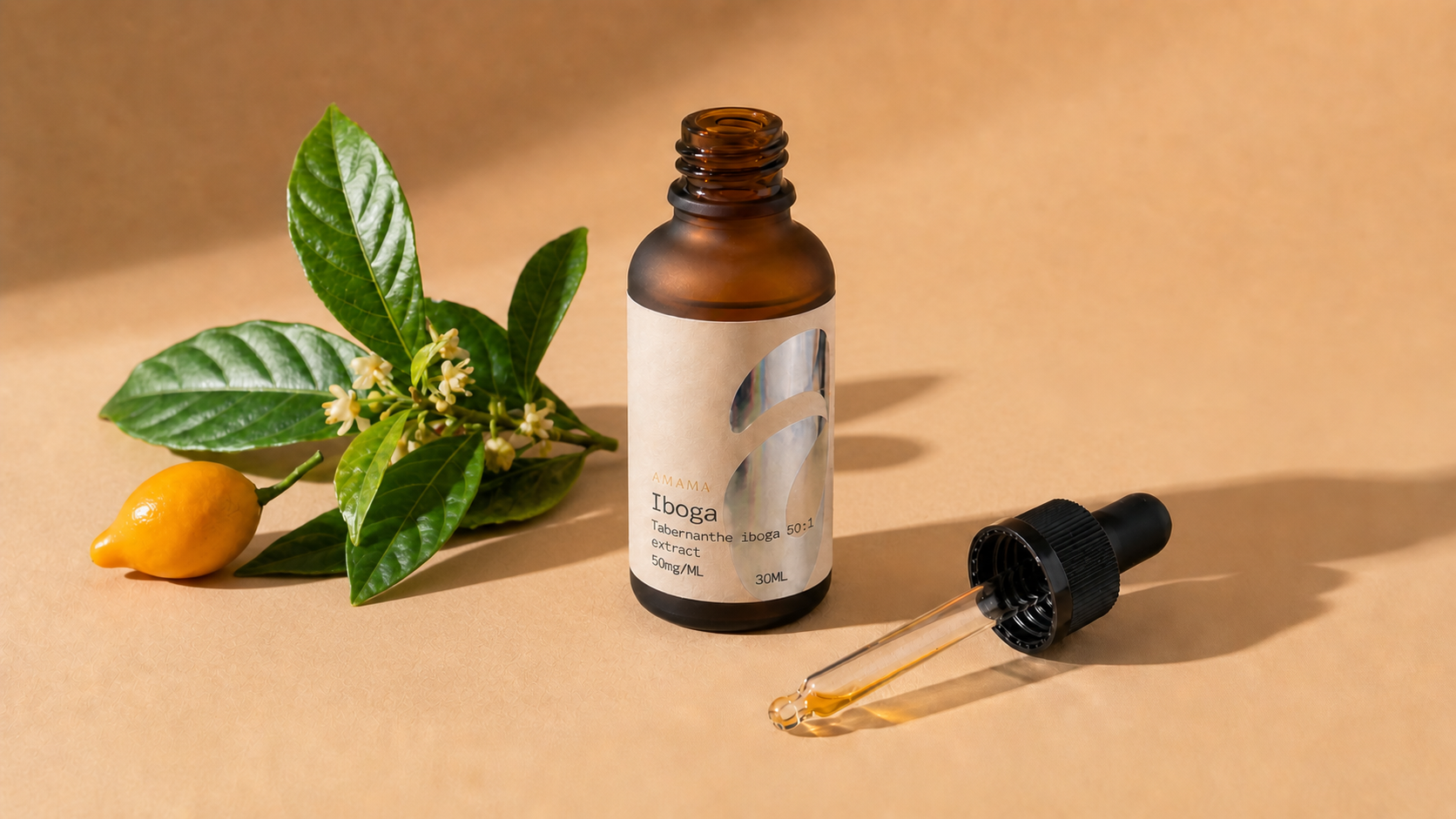
This spoke is part of our Iboga Guide.
TL;DR — Ibogaine Therapy in Europe
 Indole alkaloid · Tabernanthe iboga
Ibogaine
(1R,15R,17S,18S)-17-ethyl-7-methoxy-3,13-diazapentacyclo[13.3.1.02,10.04,9.013,18]nonadeca-2(10),4(9),5,7-tetraeneMolecular formula: C20H26N2OMolecular weight: 310.4 g/molCAS: 83-74-9Read more about Ibogaine →
>
Ibogaine, the main alkaloid of the Central African plant Tabernanthe iboga, has been researched since the 1980s in medically supervised settings for the treatment of opioid dependence, alcoholism, PTSD and treatment-resistant depression. In Germany, ibogaine is not approved as a medicine, so German-speaking patients typically travel to legal treatment centers in Portugal, Spain or the Netherlands. Due to serious cardiac risks (QT prolongation), a complete medical screening before any use is indispensable.
>
- Main indications in research: opioid detox, alcohol dependence, PTSD, treatment-resistant depression, TBI rehabilitation
- Mechanism of action: "neuronal reset" via GDNF normalization, serotonergic modulation, memory reconsolidation
- European options: Tabula Rasa Retreat (Portugal), Madera Sagrada (Spain), several Amsterdam clinics (Netherlands)
- Mandatory screening: ECG, liver values, medication history, psychiatric evaluation
- Risk without screening: approx. 1 in 300 cases potentially life-threatening (GITA data)
What is ibogaine used for therapeutically?
Clinical research on ibogaine focuses on indications where conventional therapies often reach their limits — particularly chronic addictive disorders and trauma-related conditions. Characteristically, even a single supervised session has shown long-lasting effects in several observational studies, whereas many standard therapies rely on permanent medication.
Ibogaine
| Indication | Research Status | Evidence Level |
|---|---|---|
| Opioid dependence (withdrawal interruption) | Mash et al. (2018, St. Kitts cohort, n=191); Noller et al. (2018, New Zealand cohort, 12-month follow-up) | Observational studies, no RCT |
| Alcohol dependence | Preclinical (Carnicella et al. 2010); smaller case series | Early |
| PTSD / trauma (veterans) | Cherian et al. (2023, Stanford, Nature Medicine, n=30) — ibogaine + magnesium, significant reduction of PTSD, depression, anxiety, disability | Open-label, pilot study |
| Treatment-resistant depression | Alper et al. (2012) — review; MAPS-funded follow-up studies ongoing | Early |
| TBI (traumatic brain injury) | Stanford 2023 — veterans with traumatic brain injury | Early, exploratory |
The Stanford study (Cherian et al. 2023) is so far the methodologically most robust data point: 30 US veterans with combined diagnoses (PTSD, depression, TBI) received ibogaine together with intravenous magnesium at a Mexican clinic. The effect sizes after one month were unusually large — however, this is an uncontrolled observation, not a randomized trial. A follow-up study with a control group is in preparation.
The neurobiological reset: how ibogaine affects addiction pathways
The so-called "neuronal reset" hypothesis (Alper 2012) describes why a single ibogaine session can produce effects that repeated doses of other substances fail to achieve. Several mechanisms presumably interact:
GDNF restoration. Carnicella et al. (2010) showed in animal models that ibogaine increases the concentration of glial cell line-derived neurotrophic factor (GDNF) in the ventral tegmental area (VTA). GDNF stabilizes dopaminergic neurons whose signaling becomes dysregulated by chronic substance use. This may explain why craving for opioids and alcohol measurably decreases after a single session.
Serotonergic normalization. Ibogaine acts as a serotonin reuptake inhibitor and modulates several 5-HT receptors. Combined with its NMDA-antagonistic action, this yields a profile with parallels to ketamine — but with a significantly longer duration of action (12–36+ hours).
Memory reconsolidation via sigma-2 receptors. Ibogaine shows pronounced affinity for the sigma-2 receptor, which is involved in memory processes and emotional processing. Studies suggest that during the active window, traumatic and addiction-associated memories may be re-"stored" in a plastic state — a process that many treated individuals subjectively describe as an intense life review.
Noribogaine as long-term metabolite. The liver metabolite noribogaine is pharmacologically active, has a half-life of several days, and is considered co-responsible for the sustained anti-craving window following the acute session.

Tabernanthe iboga plant at the Meise Botanic Garden, Belgium.
Jardin botanique de Meise · CC BY-SA 3.0
Treatment options in Europe (for German-speaking patients)
Since ibogaine is not approved as a medicine in Germany (but is legally possessable — neither Tabernanthe iboga nor ibogaine are listed in the BtMG or NpSG), therapeutic use takes place almost exclusively abroad within Europe. The following centers are considered established and work with medical personnel and cardiac screening:
| Center | Country | Specialization | Note |
|---|---|---|---|
| Tabula Rasa Retreat | Portugal (Sintra) | Addiction, PTSD, depression | Medically supervised, mandatory cardiac screening, structured integration |
| Madera Sagrada | Spain (Órgiva) | Addiction, trauma | Ceremonial + therapeutic programs, Bwiti influences |
| Amsterdam clinics | Netherlands | Opioid detox, depression | Ibogaine legal, several centers, often physician-led |
| Iboga Life / ex-Sanandao network | Portugal / Netherlands | Addiction | International orientation |
Belgium, France, Switzerland, the United Kingdom, Ireland, Sweden and Norway have banned ibogaine — treatment is not legally possible there.
What patients can expect: a typical process
1. Intake and pre-screening (weeks in advance). Medical history, medication list, psychiatric assessment. Many centers require a current cardiology report including 12-lead ECG, liver values, kidney function and a pregnancy test. QT-prolonging medications (certain antidepressants, antibiotics, antipsychotics) are absolute exclusion criteria if they cannot be discontinued in time.
2. Medication tapering. SSRIs, SNRIs, MAO inhibitors and opioid agonists (methadone, buprenorphine) must be discontinued before the session or switched to short-acting substitutes. This is done under medical supervision, often over 2–6 weeks.
3. Arrival and on-site check (1–2 days). Repeat ECG, blood pressure baseline, electrolyte check (especially potassium and magnesium). Psychological preliminary interview, goal setting.
4. Treatment day. The session takes place in a quiet, darkened room with medical personnel present. Continuous ECG monitoring over 12–24 hours is standard. The acute effect lasts 8–12 hours, subtle after-effects 24–36 hours.
5. Follow-up observation (at least 24h). Transition into a rest phase. No being alone during the first 48 hours.
6. Integration. Reputable centers offer several integration sessions — on-site and/or remotely in the weeks after. The length of stay is typically 5–7 days minimum, longer in complex cases.
Safety protocol: what every reputable clinic must ensure
The Global Ibogaine Therapy Alliance (GITA) published guidelines in 2015 that today represent the international de facto standard. A responsible clinic meets at least the following criteria:
- Complete cardiac assessment: 12-lead ECG with QTc measurement, echocardiogram if structural heart disease is suspected, electrolyte status
- Medication history and tapering under medical supervision
- Exclusion criteria: current SSRI/SNRI use, opioid agonists without switching, severe liver/kidney disease, pregnancy, active psychosis, long QT syndrome, severe coronary heart disease
- Psychological evaluation before treatment
- Presence of a physician or emergency paramedic throughout the entire acute phase
- Continuous cardiac monitoring at least during the first 12 hours
- Emergency equipment (defibrillator, IV magnesium, advanced resuscitation medication)
- Structured integration after the session
From the known fatalities of recent decades (Alper et al. 2012, retrospective analysis), it can be inferred: approximately 1 in 300 cases without adequate cardiac screening can potentially be life-threatening. The majority of these events occurred in underground settings with unknown health status, mixed consumption or QT-prolonging medications that had not been discontinued.
Ibogaine therapy should take place exclusively in medically supervised settings with complete cardiac screening. Underground sessions, weekend "retreats" without a physician and self-administration are not serious options — regardless of the substance's legal status.
Excursus: Bwiti ceremonies vs. clinical application
Traditional Bwiti initiation in Gabon and Cameroon and clinical ibogaine treatment are historically related but structurally different practices. One is not a substitute for the other.
| Aspect | Bwiti ceremony | Clinical ibogaine therapy |
|---|---|---|
| Substance | Crushed root bark, full alkaloid complex | Isolated ibogaine HCl (pharmaceutical purity) |
| Setting | Community house, drums, singing, Nganga (ceremony leader) | Clinic room, medical monitoring, therapists |
| Objective | Spiritual initiation, ancestor contact, rite of passage | Symptom reduction, craving interruption, trauma processing |
| Framework interpretation | Religious-cosmological | Clinical-psychological |
| Duration | Often 2–3 days | 1 day acute + integration |
| Risk profile | Depends on participants' health; traditionally without ECG | Medically secured |
Both contexts are legitimate within their respective traditions. Western patients seeking a therapeutic intervention, however, should clearly distinguish between ceremonial and clinical ibogaine use — and honestly assess which framework suits their concern and state of health. Some European centers (such as Madera Sagrada) deliberately work with hybrid formats, combining ceremonial elements with medical safeguards.
Outlook: Will ibogaine come to Germany?
The regulatory landscape has changed significantly between 2023 and 2026. Several developments suggest that ibogaine will come into greater focus of European regulatory authorities in the coming years:
- Stanford 2023 delivered the first high-quality pilot study in a Western academic context
- Texas approved 100 million US dollars for ibogaine research in 2025 — the largest single psychedelic research funding in US history
- Trump's Executive Order of April 18, 2026 mandates the FDA with an accelerated review procedure for ibogaine
- MAPS and other organizations are advancing clinical Phase II studies
For German approval, the realistic path would be:
- EMA-compliant Phase II and Phase III studies (usually 3–6 years)
- BfArM review following successful EMA evaluation
- Pilot programs in university clinics, possibly initially within the framework of compassionate use regulations (§ 41 AMG)
- The Netherlands and Portugal could serve as EU-internal model states, since clinical infrastructure and experience already exist there
A realistic forecast: 5–10 years until a possible regular approval of ibogaine as a medicine in Germany — provided that the ongoing Phase II studies deliver positive safety and efficacy data. Until then, the legal situation remains as it is: ibogaine is legally possessable in Germany, but not an approved medicine, and therapeutic use takes place abroad within Europe.
Back to the overview
Back to the Iboga Guide | Iboga Effects | Iboga Legal Status 2026 | Iboga vs. Psilocybin
Last updated: April 2026. This content is for informational purposes only and does not constitute medical advice. Not a medical product. For medical questions, please consult a physician.
→ Ibogaine Compound Profile — chemistry, pharmacology & references