

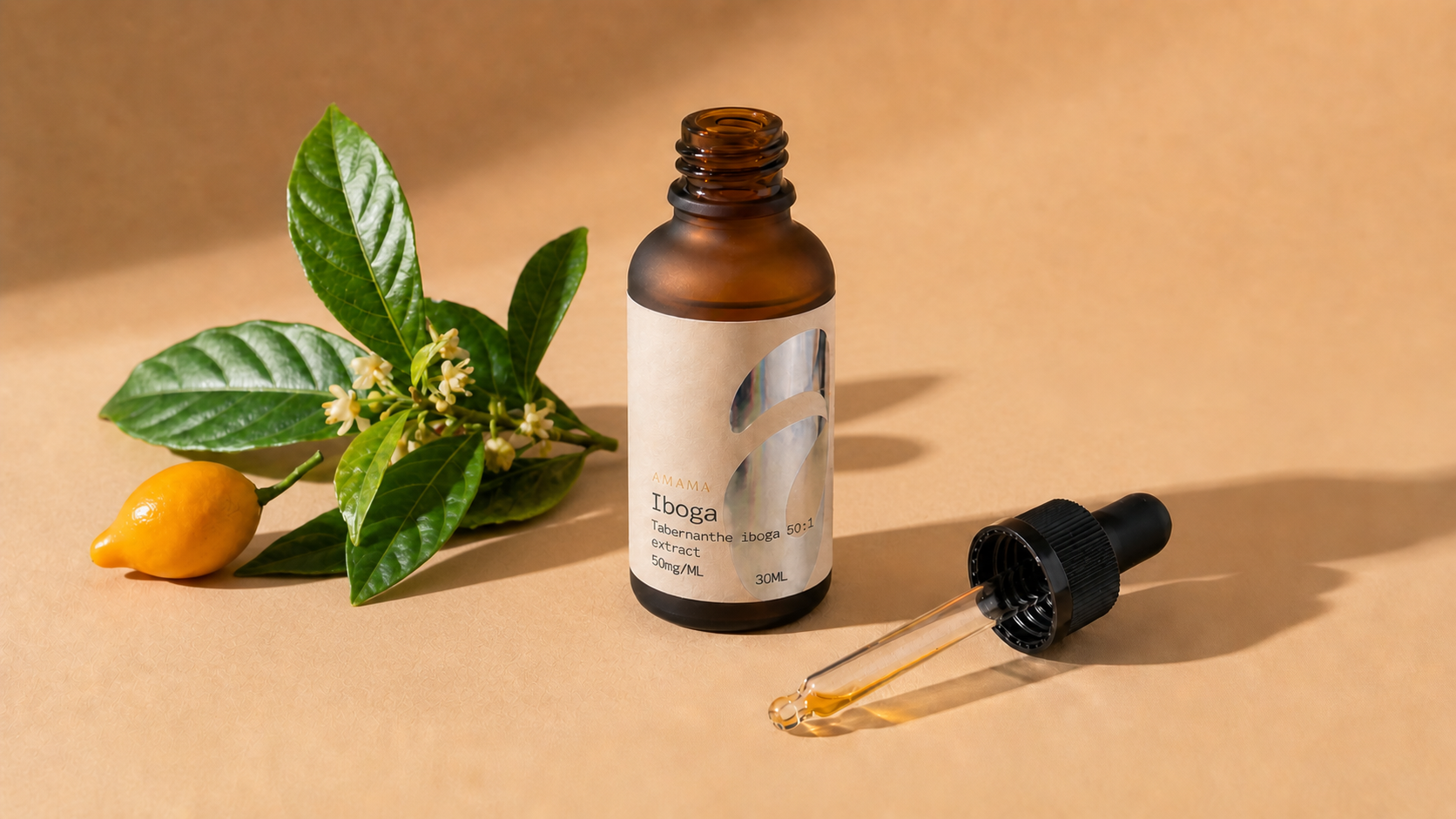
This spoke is part of our Iboga Guide.
TL;DR — Iboga (Tabernanthe iboga) contains ibogaine as its main alkaloid, a tryptamine-type indole alkaloid with an unusually complex receptor profile: SERT inhibition, NMDA antagonism, kappa-opioid activity and sigma-2 affinity. At 24–36 hours, the experience is significantly longer than with other psychedelics and unfolds in two phases.
 Indole alkaloid · Tabernanthe iboga
Ibogaine
(1R,15R,17S,18S)-17-ethyl-7-methoxy-3,13-diazapentacyclo[13.3.1.02,10.04,9.013,18]nonadeca-2(10),4(9),5,7-tetraeneMolecular formula: C20H26N2OMolecular weight: 310.4 g/molCAS: 83-74-9Read more about Ibogaine →
>
- Mechanism: Multi-target pharmacology (SERT, NMDA, κ-opioid, σ2) — no single "key receptor"
- Duration: 24–36+ hours total experience — unique among psychedelics
- Two phases: acute visionary phase (0–18h) + introspective reflection phase (18–36h)
- Alkaloid hierarchy: Ibogaine (main active compound) → Noribogaine (active metabolite, longer half-life) → Tabernanthine, Ibogamine, Coronaridine
- Safety: QT prolongation is the documented main risk — potentially life-threatening without cardiac pre-screening (approx. 1 in 300 cases). ECG and medical evaluation are mandatory before any ceremonial use.
Ibogaine: The Main Active Compound
Ibogaine (CAS 83-74-9, molecular formula C₂₀H₂₆N₂O, molecular mass 310.43 g/mol, PubChem CID 3689) is a tryptamine-type indole alkaloid and the pharmacologically most significant constituent of the root bark of Tabernanthe iboga. In the dry mass of the root bark, ibogaine accounts for approximately 3% — a relatively high proportion for plant alkaloids. The remaining alkaloids of the iboga root (more than twelve identified compounds) contribute to the overall effect with different profiles and explain why the effect of the whole root bark ("Total Alkaloid Extract", TA) is not pharmacologically identical to pure ibogaine HCl.
Ibogaine
Receptor Profile: Why Iboga Works Differently
Unlike classical serotonergic psychedelics (psilocybin, LSD, mescaline), which act primarily via the 5-HT2A receptor, ibogaine shows a multi-target profile:
- Serotonin transporter (SERT) inhibition — structurally comparable to SSRIs, but with a stronger acute effect. This contributes to the sustained mood elevation after the experience.
- NMDA receptor antagonism — mediates a dissociative component, similar to (but weaker than) ketamine. Associated with the "interruption" of entrenched neuronal patterns.
- Kappa-opioid receptor activity — agonist. κ-opioid activation is considered central to the visionary quality of the experience and is also observed with salvinorin A (Salvia divinorum).
- Sigma-2 receptor affinity — studies (including Bhatt et al. 2019) suggest a role in memory reconsolidation, which could explain the biographical-reflective quality of the experience.
- Nicotinic acetylcholine receptors (α3β4) — antagonism, discussed in the context of the anti-craving effect in addictions.
This combination is pharmacologically unique. From this observation, Alper (2012) formulated the hypothesis of a "neuronal reset" — a kind of recalibration of addiction-associated neural pathways.
Noribogaine: The Underestimated Metabolite
Ibogaine is demethylated in the liver by CYP2D6 to noribogaine. Noribogaine is pharmacologically active, crosses the blood-brain barrier, and has a significantly longer half-life (several days, vs. hours for ibogaine). The sustained anti-craving effect that users report is pharmacokinetically strongly attributed to noribogaine. Clinically relevant: CYP2D6 "poor metabolizers" (approx. 7–10% of the European population) show different effect profiles — one reason why pharmacogenetic screening is standard in reputable treatment centers.
Alkaloid Comparison
| Alkaloid | Proportion in root bark | Primary mechanism | Half-life | Effect profile |
|---|---|---|---|---|
| Ibogaine | ~3% | SERT, NMDA, κ-opioid, σ2 | 4–7 h | Acute visionary phase |
| Noribogaine | Metabolite | SERT inhibition, κ-opioid | several days | Sustained mood, anti-craving |
| Tabernanthine | ~0.2% | κ-opioid (weaker), NMDA | short | Adjuvant, little researched |
| Ibogamine | Traces | σ-receptor | short | Preclinically discussed as cardioprotective |
| Coronaridine | ~0.3% | Multi-target | short | In vitro antitumor effects described |
The Two Phases of the Iboga Experience
The ceremonial iboga experience differs structurally from all other psychedelics. Users and researchers consistently describe two clearly distinguishable phases that together can span 24 to 36+ hours.
Phase 1: The Acute Visionary Phase (0–18 hours)
After a latency of 45–90 minutes, the "flood" sets in — the acute visionary phase. Characteristic features:
- REM-like rapid eye movements during waking consciousness — EEG patterns resembling waking REM states
- Vivid autobiographical image sequences — users frequently report a film-like succession of their own life moments ("life review")
- Physical heaviness, ataxia, nausea — no pleasant bodily sensations. The experience is not recreationally usable.
- Sound sensitivity — many ceremonies take place in darkened, quiet rooms
- Confrontational, non-euphoric quality — Bwiti tradition describes this as an "encounter with the ancestors"
This phase is intense, demanding, and is consistently described by users as work-intensive, not pleasurable.
Phase 2: The Introspective Reflection Phase (18–36 hours)
After the visionary phase subsides, a phase of calm wakefulness often lasting more than 12 hours follows. Sleep is barely possible in the first 24 hours. Users describe this phase as:
- cognitively clear, emotionally calm
- strongly reflective, with a sense of "ordered thoughts"
- high insight density, frequently reported as the actual "therapeutic" phase
- the majority of memory reconsolidation presumably takes place in this phase
Only after 30–40 hours does deep sleep set in.
Microdose Range: Different Pharmacology
Sub-perceptual doses (far below the flood dose) are discussed in some contexts but show a completely different effect profile — primarily mood-modulating, without a visionary phase. The alkaloid ratios (especially ibogaine/noribogaine balance) act differently in this range, and clinical evidence for microdosing is currently minimal. More in the Iboga Guide.

Dried root bark pieces of Tabernanthe iboga — the primary traditional preparation used in Bwiti ceremony.
Wikimedia Commons · CC BY-SA 4.0
What Users Report (Anecdotal Reports, Strongly Hedged)
Studies suggest that users consistently report certain experience patterns. The following account is based on published surveys and observational studies — they are self-reported and do not replace controlled clinical studies.
Reported experience patterns:
- Autobiographical life review — film-like memory sequences, often with a new emotional perspective on early life events
- Emotional catharsis — crying, release of long-held emotions
- Reduction of substance craving — particularly consistently reported for opioids and alcohol
- Sustained mood improvement — users describe effects lasting days to weeks
- Sense of a "mental reset" — frequently used metaphor
Scientific sources documenting such reports:
- Mash et al. (2018) — observational study on opioid withdrawal with ibogaine, with documented reduction of withdrawal symptoms and craving over 30 days
- Noller et al. (2018) — New Zealand study, 14 participants with opioid dependence, 12-month follow-up, significant reduction in addiction severity (ASI-Lite scores)
- Cherian et al. (2024, Nature Medicine, Stanford) — 30 military veterans, ibogaine combined with magnesium, significant improvement of PTSD, depression and anxiety symptoms
Important limitation: These studies are small, mostly without a control group, and the participants are strongly self-selected. Anecdotal reports should not be understood as clinical evidence. Larger controlled studies (MAPS, Texas Ibogaine Initiative) are underway.
Iboga vs. Classical Psychedelics
Iboga differs pharmacologically and phenomenologically markedly from other psychedelics.
| Iboga | Psilocybin | LSD | Ayahuasca | |
|---|---|---|---|---|
| Main mechanism | SERT + NMDA + κ-opioid + σ2 | 5-HT2A agonism | 5-HT2A agonism | 5-HT2A + MAO inhibition |
| Duration | 24–36+ h | 4–6 h | 8–12 h | 4–6 h |
| Phenomenology | biographical, life review | oceanic, mystical | associative, open | visionary, purgative |
| Physical | demanding, ataxia, nausea | mild | mild | purgative (vomiting) |
| Primary use | initiation (Bwiti), addiction therapy | therapy, consciousness research | therapy, creative | religious, therapeutic |
| Legal status DE | legal (not in BtMG/NpSG) | illegal (Schedule I BtMG) | illegal (Schedule I BtMG) | DMT illegal; plants grey zone |
| Cardiac risk | high (QT prolongation) | low | low | moderate (MAO inhibitor) |
Perhaps the most important difference: iboga is not a classical 5-HT2A psychedelic. It acts via different receptor pathways, and its effect on memory reconsolidation is mechanistically unique.
More on the direct comparison: Iboga vs. Psilocybin.
Safety: Risks and Contraindications
Iboga has the best-documented cardiac risk profile of all currently discussed psychedelics. This risk is real but largely manageable with appropriate screening — without screening, however, potentially life-threatening.
QT Prolongation: The Documented Main Risk
Ibogaine blocks hERG potassium channels and can thereby prolong the QT interval on the ECG. Significant QT prolongation can lead to torsades de pointes (a potentially fatal cardiac arrhythmia). Documented deaths (Alper et al. 2012, Koenig & Hilber 2015) are almost exclusively associated with:
- pre-existing, often undetected heart disease
- electrolyte disturbances (hypokalemia, hypomagnesemia)
- co-medication with QT-prolonging substances
- opioid co-medication during active dependence
Approx. 1 in 300 cases may proceed potentially life-threateningly without cardiac pre-screening. With adequate screening, this risk decreases considerably.
Absolute Contraindications
- known heart disease (arrhythmias, long-QT syndrome, heart failure)
- ongoing SSRI/SNRI medication (serotonin syndrome risk + additive QT prolongation)
- opioids (additive cardiac risk)
- benzodiazepines (CYP interaction)
- MAO inhibitors
- pregnancy, breastfeeding
- liver or kidney insufficiency
- active psychotic disorders
Required Screening Before Ceremonial Use
The Global Ibogaine Therapy Alliance (GITA) Clinical Guidelines (2015) define a minimum standard:
- Resting ECG with QTc determination
- Electrolytes (potassium, magnesium, calcium)
- Liver values (ALT, AST, γGT)
- Kidney values (creatinine)
- Pharmacogenetics (CYP2D6 status, in specialized centers)
- complete medication and substance history
The systematic review by Litjens & Brunt (2016) concluded that the vast majority of documented serious incidents occurred in lay contexts without medical screening — while supervised clinical settings (Netherlands, Mexico, New Zealand) show a significantly more favorable safety profile.
Safety notice: Iboga products from amama are traditional botanicals or ethnobotanical collector's items, not therapeutic products and not food or medicinal products. Any form of medical or ceremonial use requires medical supervision with complete cardiac and pharmacological screening. German-speaking users typically travel to treatment centers in the Netherlands or Portugal (e.g. Tabula Rasa Retreat, Sintra).
Back to Overview
Back to the Iboga Guide | Iboga & Therapy | Iboga Legal Status Germany | Iboga vs. Psilocybin
Last updated: April 2026. This content is for informational purposes only and does not constitute medical advice.
→ Ibogaine Compound Profile — chemistry, pharmacology & references