

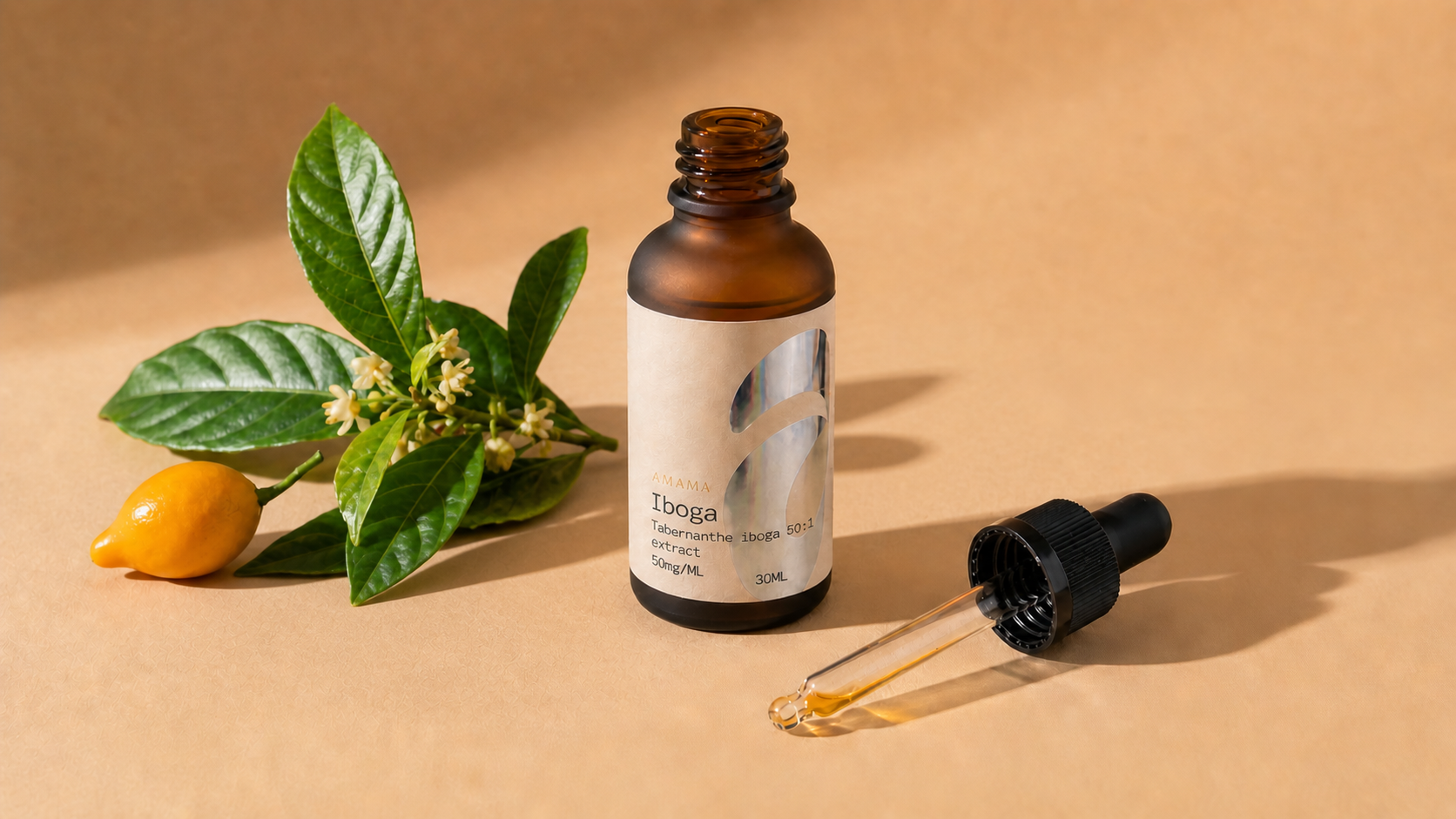
TL;DR — Iboga in brief: Iboga (Tabernanthe iboga) is a Central African shrub of the dogbane family (Apocynaceae), whose root bark contains the indole alkaloid ibogaine. For centuries, iboga has been the sacrament of the Bwiti religion of Gabon (UNESCO Intangible Cultural Heritage since 2022). In recent years, iboga has moved into the focus of modern neuroscience through studies on addiction, PTSD, and depression — most recently through the 2023 Stanford study and the US Executive Order of April 2026.
 Indole alkaloid · Tabernanthe iboga
Ibogaine
(1R,15R,17S,18S)-17-ethyl-7-methoxy-3,13-diazapentacyclo[13.3.1.02,10.04,9.013,18]nonadeca-2(10),4(9),5,7-tetraeneMolecular formula: C20H26N2OMolecular weight: 310.4 g/molCAS: 83-74-9Read more about Ibogaine →
- What it is: Root bark of the shrub Tabernanthe iboga, primary alkaloid ibogaine (CAS 83-74-9).
- Origin: Gabon, Cameroon, Republic of Congo — sacred use in the Bwiti tradition.
- Effects: Ibogaine acts on serotonin reuptake, NMDA receptors, kappa-opioid and sigma-2 receptors — mechanistically unique, not comparable to classical psychedelics.
- Research: Stanford 2023 (Cherian et al., Nature Medicine), MAPS studies, Texas Ibogaine Initiative (USD 100 million, 2025).
- Legal status DE: Legal — neither Tabernanthe iboga nor ibogaine are listed under the BtMG or NpSG (as of April 2026). Not approved as a medicine or food.
- Safety: Cardiac risks (QT prolongation) — without medical pre-screening, iboga can potentially be life-threatening in approximately 1 in 300 cases.
- At amama: Iboga root bark as a traditional ethnobotanical / collector's item — not for consumption, not as medicine.

Tabernanthe iboga plant at the Meise Botanic Garden, Belgium.
Jardin botanique de Meise · CC BY-SA 3.0
What is Iboga?
Iboga refers to the low-growing shrub Tabernanthe iboga (Baill., 1889) of the Apocynaceae family (dogbanes) — related to periwinkle (Vinca), oleander, and Rauwolfia serpentina. The plant reaches 1–2 meters in height, grows in the understory of Central African rainforests, and bears yellow-orange, edible fruits. The medicinally and culturally relevant part of the plant, however, is the root bark, in which the characteristic indole alkaloids are concentrated.
The terminological distinction is important:
- Iboga = the entire plant or the prepared root bark (traditional context).
- Ibogaine = the isolated primary alkaloid (pharmacological/clinical context).
In the Fang language of Gabon, the plant is called "eboka" — a term that encompasses both the plant and the sacrament prepared from it. According to ethnobotanical estimates, the Mitsogho and Fang of Gabon have used iboga for at least several centuries, possibly longer, as medicine, as a hunting aid (in low doses for alertness), and above all as a spiritual sacrament.
Botanically noteworthy: The Apocynaceae are an alkaloid-rich family. Many of its members produce complex indole and monoterpene alkaloids — from vincristine (oncology) to reserpine (blood pressure) to ibogaine itself. Iboga is not an isolated case, but part of a pharmacologically dense plant family.
Ibogaine
Origin: The Bwiti Tradition
The Bwiti religion is the cultural heart of iboga use. It originated among the Mitsogho in central Gabon and spread in the 19th and 20th centuries to the Fang and other ethnic groups. Today, Bwiti is a recognized religion of Gabon with its own temples, priests (nganga), and liturgy. In 2022, the Bwiti tradition was recognized by UNESCO as Intangible Cultural Heritage of Humanity — a cultural-political milestone.
The Initiation
At the center of Bwiti practice stands the initiation (bwete), a multi-day ritual in which the initiate ingests a high dose of iboga root bark. The ceremony follows a precise structure:
- Preparation: Days to weeks of diet, purification, questions posed to the community.
- The rite: Ingestion of the root bark in a temple (mbandja), accompanied by ngombi harp, ritual chants, and the fire.
- The journey: Effects set in after 30–60 minutes and last 12–36 hours; the initiate experiences intense visionary phases, followed by deep introspection.
- The return: The community accompanies the initiate, interprets visions, and integrates the experience into the social context.
The Bwiti context differs fundamentally from any recreational use: here iboga is a sacrament, not a drug — embedded in centuries of traditional knowledge, the cardiac experiential wisdom of the initiates, and a ritual framework that reduces risks.
Western Reception
European pharmacologists first mentioned iboga at the end of the 19th century. Systematic research began with Léon Pales (1950s, colonial ethnobotany of Gabon) and intensified in the 1960s through work on alkaloid chemistry. Chilean psychiatrist Claudio Naranjo (1969) published the first Western clinical observations on the therapeutic use of low ibogaine doses. The decisive impulse for addiction research, however, came through Howard Lotsof (1962), who accidentally discovered the craving-interrupting effect on himself and patented it in the 1980s.
The Active Compounds: Ibogaine and Its Companion Alkaloids
| Property | Value |
|---|---|
| Scientific name | Tabernanthe iboga (Baill., 1889) |
| Family | Apocynaceae (dogbanes) |
| Primary alkaloid | Ibogaine, CAS 83-74-9 |
| Molecular formula | C₂₀H₂₆N₂O (MW 310.43 g/mol) |
| PubChem CID | 3689 |
| Other alkaloids | Noribogaine, tabernanthine, ibogamine, coronaridine |
| Ibogaine content in root bark | approx. 3% of dry mass |
| Origin | Central Africa — Gabon, Cameroon, Congo |
| Traditional use | Bwiti religion (initiation rite) |
| Legal status (DE) | Legal — listed under neither BtMG nor NpSG |
Ibogaine: An Alkaloid with a Unique Profile
Ibogaine is an indole alkaloid of the tryptamine type — structurally, then, distantly related to serotonin, DMT, or psilocin, but pharmacologically fundamentally different. While classical psychedelics act primarily as 5-HT2A agonists, ibogaine binds to several receptor systems simultaneously:
- Serotonin reuptake inhibition (SERT): similar to SSRIs, but considerably more complex.
- NMDA receptor antagonism: comparable to ketamine — relevant for neuroplasticity and addiction mechanisms.
- Kappa-opioid activity: partial agonist — involved in dysphoria, but also in reset mechanisms.
- Sigma-2 receptor affinity: a still poorly understood target, possibly relevant for the visionary quality.
- nAChR modulation: effects on nicotinic acetylcholine receptors, which supports the reports on smoking cessation.
From this polyreceptor profile arises the "neuronal reset" hypothesis (Alper, 2012; Glick & Maisonneuve): ibogaine is said to "recalibrate," as it were, dopaminergic reward pathways that are dysregulated in chronic substance use. Studies suggest that a single ibogaine exposure raises the release of neurotrophic factors (GDNF, BDNF) in the ventral tegmentum — a plausible mechanism for the reported long after-effect.
Noribogaine: The Long Breath
Ibogaine is metabolized in the liver via CYP2D6 into noribogaine (12-hydroxyibogamine). Noribogaine is pharmacologically active, acts more strongly at SERT, and has a significantly longer half-life than ibogaine itself. The often-reported "after phase" of days to weeks following a ceremony is largely attributed to noribogaine. Clinically relevant: CYP2D6 poor metabolizers (~7% of Europeans) break down ibogaine more slowly — an additional safety factor that should be clarified before any ceremonial use.
Companion Alkaloids
In addition to ibogaine, iboga root bark contains a complex alkaloid spectrum:
- Tabernanthine — structurally close to ibogaine, lower potency.
- Ibogamine — milder effect, possibly involved in antiarrhythmic effects (subject of current research).
- Coronaridine — with its own pharmacological profile, investigated among other things for antiplasmodial activity.
These companion alkaloids are the reason why proponents of the "Total Alkaloid Extract" (TA) prefer the whole plant over pure ibogaine HCl — the classic phyto-argument of synergy. However, clinical evidence for this is limited; Stanford and most modern studies work with pure ibogaine.

Dried root bark pieces of Tabernanthe iboga — the primary traditional preparation used in Bwiti ceremony.
Wikimedia Commons · CC BY-SA 4.0
Effects: What Do Users Report?
For context: the following descriptions draw on ethnographic reports (Fernandez, 1982), clinical observations from retreat centers, and case reports — not clinical efficacy claims. Every person responds individually.
Two phases of a complete ceremonial iboga experience are reported:
Phase 1 — Acute visionary phase (approx. 4–18 hours)
Users describe this phase as "flood" or "flooding":
- Sets in 30–90 minutes after ingestion.
- Pronounced, often autobiographical image sequences — memories, life themes, inner scenes.
- Frequently with eyes closed; many find open eyes overwhelming.
- Strong physical dimension: ataxia, motor restlessness or blockade, nausea (interpreted as purification in the Bwiti tradition), auditory hyperacusis ("audio brain").
- Qualitatively not euphoric — users emphasize the serious, often confrontational character.
Phase 2 — Reflective phase (approx. 18–36+ hours)
- Visions fade, alertness remains high — sleep usually only possible after 24–48 hours.
- Introspective analysis of what was experienced, emotional processing.
- Reported: reduced substance cravings (especially for opioids, nicotine, alcohol), emotional clarity, altered self-image.
- After-effect: Many users report an "open window phase" of 2–6 weeks, during which behavioral changes come more easily — presumably noribogaine-mediated.
Traditional ceremonial dose vs. microdose
- Ceremonial dose (flood): high in Bwiti rituals, taken over hours, always under ritual supervision.
- Microdose range: considerably lower, non-visionary, reported in some communities for mental clarity and mood modulation. Scientific evidence for this is very limited; the cardiac risks exist at low doses as well.
In-depth article: Iboga effects in detail.
Iboga & Addiction: What the Research Shows
Modern research on ibogaine focuses on three indications: opioid dependence, PTSD/trauma, and depression/anxiety.
Stanford 2023 — the breakthrough
The study Cherian et al., Nature Medicine (2024, online 2023) examined 30 US veterans with Traumatic Brain Injury (TBI) and PTSD who received a single ibogaine treatment combined with intravenous magnesium (as QT protection) in Mexico. Results:
- Significant reduction in PTSD, depression, and anxiety symptoms.
- Sustained improvement over months following a single session.
- Improvements in neuropsychological functions (executive function, processing speed).
- No serious cardiac events under the magnesium protocol and screening.
The study is small and uncontrolled — but the effect sizes and persistence make it one of the most frequently cited pieces of evidence for further RCTs.
MAPS, HAI, GITA
- MAPS (Multidisciplinary Association for Psychedelic Studies) conducts observational studies and is planning RCTs.
- The HAI program (Healing Addiction with Ibogaine) collects long-term data from retreat contexts.
- The Global Ibogaine Therapy Alliance (GITA) published clinical guidelines in 2015 (screening, dosing, monitoring) — still the de facto standard among reputable providers today.
The Opioid Context
Ibogaine shows a property that no other known molecule offers: it interrupts acute opioid withdrawal within hours, without itself acting as an opioid agonist. The clinical hypothesis: ibogaine and noribogaine "reset" dopaminergic reward pathways that are dysregulated by chronic opioid use. For those affected by years of heroin or fentanyl dependence, this is revolutionary — which is why Texas in 2025 made USD 100 million available for clinical ibogaine research, the largest single investment in psychedelic research in US history.
In depth: Iboga & Therapy — research and protocols. Comparison with classical psychedelics: Iboga vs. Psilocybin.
Legal Status in Germany and Europe
Germany: Legal — but not a medicine
As of April 2026: Neither Tabernanthe iboga (plant, root bark) nor ibogaine are listed in any schedule of the Narcotics Act (BtMG, Schedules I–III). The New Psychoactive Substances Act (NpSG) also does not cover ibogaine — its substance-group definition targets synthetic cannabinoids, cathinones, phenethylamines, and certain tryptamines, but does not cover the iboga alkaloid profile.
Consequence: The purchase, possession, and sale of iboga root bark as a traditional ethnobotanical are legal in Germany.
However:
- Ibogaine is not approved as a medicine (neither in DE nor EU-wide).
- Iboga is not approved as a food (novel food status unclear; consumption is not a permissible purpose).
- Medical marketing claims (healing promises) are not permitted (HWG, LMIV).
- amama sells iboga exclusively as a traditional botanical collector's item / ethnobotanical, not for consumption and not for medicinal use.
Details and sources: Iboga & Legal Status Germany 2026.
Europe overview
| Country | Status |
|---|---|
| Germany | Legal (neither BtMG nor NpSG) |
| Netherlands | Legal — active treatment centers in the Amsterdam area |
| Portugal | Legal — retreat clinics, incl. Tabula Rasa Retreat (Sintra) |
| Spain | Gray area — retreats exist (e.g. Madera Sagrada, Órgiva) |
| Switzerland | Prohibited — listed as a controlled substance |
| Austria | Gray area — not explicitly listed, but medicines law applies |
| France | Prohibited (since 2007) |
| Belgium | Prohibited |
| United Kingdom | Prohibited (Psychoactive Substances Act 2016) |
| Ireland | Prohibited |
| Norway | Prohibited |
| Sweden | Prohibited |
German-speaking people interested in a supervised ibogaine treatment travel in practice predominantly to the Netherlands or to Portugal.
USA: The Trump Executive Order (April 2026)
Internationally, the largest regulatory upheaval in decades is underway: until now, ibogaine has been Schedule I in the USA (illegal). On April 18, 2026, President Trump signed an Executive Order accelerating FDA review of ibogaine. The context:
- Texas Ibogaine Initiative (2025): USD 100 million for research, initiated by ex-governor Rick Perry and W. Bryan Hubbard.
- Joe Rogan discussed ibogaine in JRE #2477 (April 1, 2026) with Rick Perry and Hubbard; Rogan was present at the signing at the White House. In the days before, Rogan texted Trump on the topic; Trump's reported response: "Sounds great. Do you want FDA approval? Let's do it."
- Consequence: FDA fast-track for Phase 2 and Phase 3 studies, expected approval decision 2028–2030.
The European EMA typically follows US precedent with a 2–4 year delay — a possible EU approval is conceivable in the early 2030s at the earliest.
Safety and Risks
⚠ SAFETY NOTICE — CARDIAC RISK: Ibogaine can prolong the QT interval and in rare cases lead to life-threatening cardiac arrhythmias (Torsades de Pointes). According to GITA guidelines and published case series, the risk of a potentially fatal event is approximately 1 in 300 cases without cardiological pre-screening. Ceremonial or therapeutic use mandatorily requires: ECG, electrolyte status (magnesium, potassium), medication screening, medical monitoring.
Concrete risk factors
- QT prolongation: Ibogaine prolongs the QT interval in a dose-dependent manner. Risk: Torsades de Pointes, cardiac arrest.
- Electrolyte disturbances: Low magnesium or potassium potentiates the risk — the reason modern protocols (Stanford) co-administer IV magnesium.
- CYP2D6 status: Poor metabolizers have elevated ibogaine levels.
- Concomitant medication: Contraindicated in particular are
- SSRIs/SNRIs/MAO inhibitors (serotonin syndrome risk),
- Opioids (QT and respiratory depression),
- Antiarrhythmics, antipsychotics, certain antibiotics (QT-additive),
- Stimulants.
- Pre-existing conditions: Heart disease, long QT syndrome, hepatic insufficiency, severe psychiatric disorders (especially psychoses) are contraindications.
Why retreat centers work the way they do
Reputable centers in the Netherlands and Portugal require before a treatment: ECG, blood count, liver metabolite test, medication history, psychiatric assessment. During the session: continuous ECG monitoring, intravenous access, medical presence. Precisely this effort explains the safety record of scientific studies in contrast to unsupervised self-experimentation.
amama and iboga: clear positioning
amama sells iboga root bark exclusively as a traditional ethnobotanical / collector's item. We:
- do not sell as a medicine,
- do not sell as a food,
- make no healing promises,
- recommend no consumption dosages,
- refer those with a therapeutic concern to accredited treatment centers in the Netherlands or Portugal.
Buying Iboga: What amama Offers
As a Berlin ethnobotanical smartshop (online: amama.space, in-store in Berlin-Neukölln), we carry selected iboga products with traceable origin:
- Iboga root bark (Tabernanthe iboga) — ethically sourced, ideally from sustainable cultivation (not from wild collection of the endangered wild population in Gabon).
- Laboratory analysis for identity and contaminants.
- Traceable sourcing — documented supply chain.
- Declaration as a traditional ethnobotanical, not for consumption.
Full collection: COLLECTION: iboga
Related Topics
The deeper spokes to this guide:
- Iboga effects in detail — phases, mechanism, user reports.
- Iboga & Legal Status Germany 2026 — BtMG, NpSG, Europe overview, US update.
- Iboga & Therapy — Stanford study, MAPS, treatment centers.
- Iboga vs. Psilocybin — mechanism, duration, fields of use.
Related ethnobotanicals at amama:
→ Ibogaine Compound Profile — chemistry, pharmacology & references
In Which Forms Is Iboga Typically Available?
Iboga is encountered in several formats — each with different alkaloid concentration, handling, and traditional alignment.
| Root bark shavings | The traditional Bwiti format. Ibogaine concentration ~3% of dry weight. Closest to original ceremonial preparation. |
| Iboga powder (gemahlen) | Finely ground root bark. Same alkaloid concentration as shavings; easier to weigh and homogenise. |
| Iboga capsules | Pre-measured root-bark powder in capsules. Convenient for reference dosing or microdosing protocols. |
| Iboga tincture / tropfen | Alcohol- or glycerine-based liquid extract. Variable concentration; quality verification matters. |
| Ibogaine HCl / extract | Isolated alkaloid in salt form. The most potent format and the form used in clinical research and treatment centers. |
| Räucherwerk / incense | Some suppliers position iboga material as ceremonial incense. The pharmacological profile of combusted iboga differs significantly from oral preparation. |
What amama carries: when in stock, our iboga catalogue focuses on root-bark shavings and powdered root bark — closest to traditional preparation. We do not currently sell capsules, tinctures, or concentrated ibogaine extracts. Browse our Iboga collection →
For chemistry, mechanism, and published research on the principal alkaloid: Ibogaine — Compound Profile →