

TL;DR
| Botanical name | Mitragyna speciosa (Korthals, 1839) |
| Plant family | Rubiaceae (coffee family) |
| Origin | Southeast Asia — Thailand, Malaysia, Indonesia (Borneo) |
| Primary alkaloids | Mitragynine (~66 %), 7-Hydroxymitragynine (~2 %) |
| Available forms | Powder, capsules, liquid extract |
| Legal status (DE) | Legal — not listed in BtMG or NpSG |
This is the seventh and final article in our kratom series. For the overarching context on Mitragyna speciosa, see the kratom guide. We will be publishing a standalone kanna pillar shortly — until then, this comparison offers the first key data points on Sceletium tortuosum.
In brief
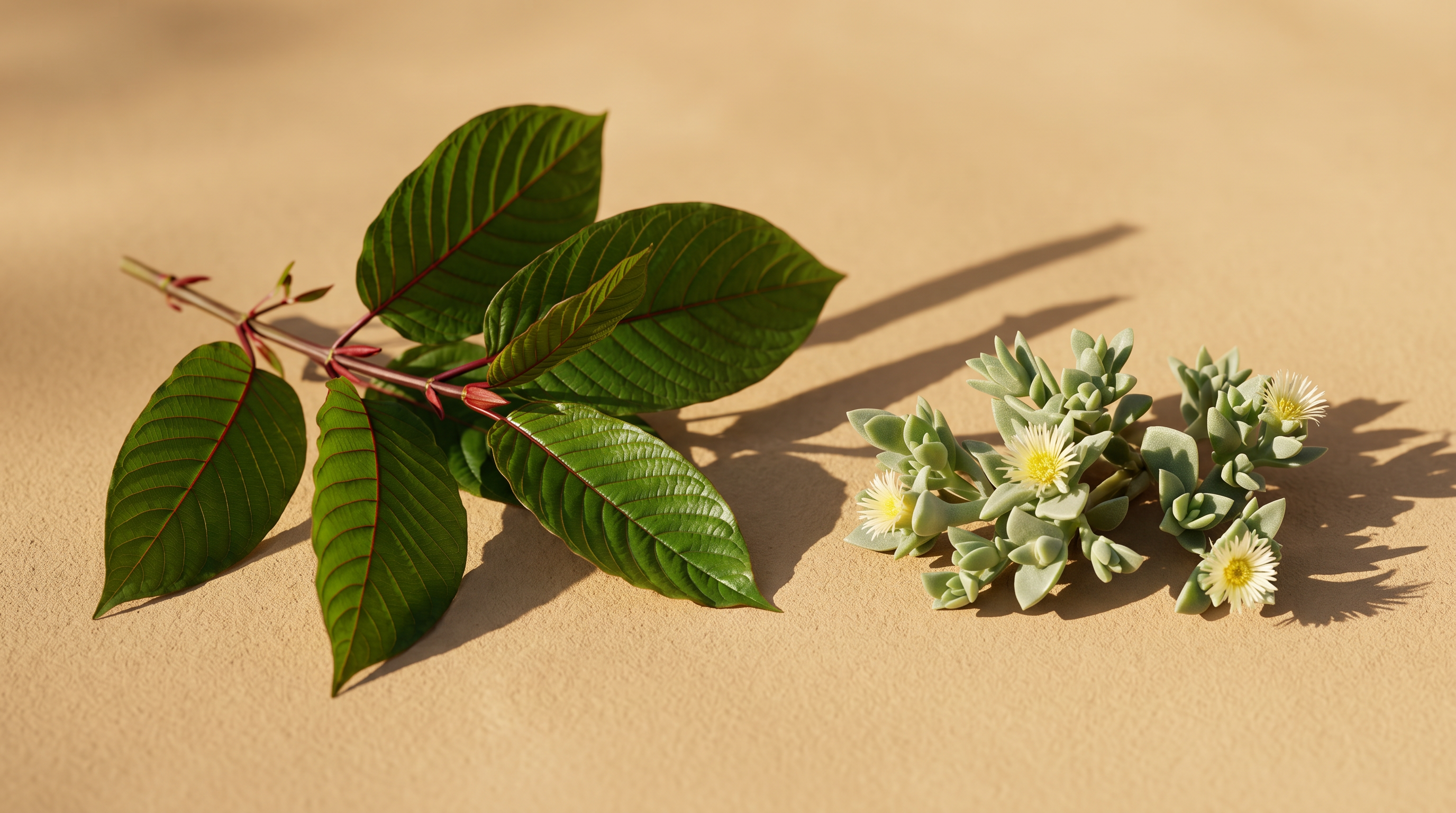
Kratom and kanna are two of the most important legal ethnobotanicals on the German market. Both have documented traditional applications: kratom in Southeast Asia (Thailand, Malaysia, Kalimantan) as a tea or chewed leaf, kanna among the Khoisan in southern Africa as a fermented product (kougoed). Both are not listed under the Narcotics Act (BtMG) or the New Psychoactive Substances Act (NpSG).
Despite these parallels, the two plants differ fundamentally in their pharmacology. Kratom primarily acts on the opioid system, kanna on the serotonin system. This difference determines when which plant makes sense — and when not.

Original botanical plate from Korthals' 1839 scientific description of Mitragyna speciosa — the first formal classification of the kratom tree.
Dutch Colonial Botanical Survey, Netherlands East Indies · Public Domain
Mechanism compared
| Property | Kratom (*Mitragyna speciosa*) | Kanna (*Sceletium tortuosum*) |
|---|---|---|
| Plant family | Rubiaceae (coffee family) | Aizoaceae (ice plant family) |
| Origin | Southeast Asia (Borneo, Thailand, Malaysia) | Southern Africa (Karoo, South Africa) |
| Primary active compound | Mitragynine, 7-hydroxymitragynine | Mesembrine, mesembrenone, mesembrenol |
| Main mechanism | Partial μ-opioid receptor agonist (G-protein bias) | Serotonin reuptake inhibitor (SRI) + PDE4 inhibitor |
| Secondary activity | Adrenergic, serotonergic | VMAT-2 modulation |
| Effect profile | Relaxing to activating (strain-dependent) | Mood-lifting, social, clear |
| Onset (oral) | approx. 15–30 minutes | approx. 20–45 minutes |
| Duration | approx. 3–5 hours | approx. 2–4 hours |
| Dependence potential | Possible with long-term heavy use | Low (according to current research) |
| Legal status (DE) | Legal (not listed in BtMG/NpSG) | Legal (not listed in BtMG/NpSG) |
| Combination with SSRIs | Caution | Contraindicated |
The table shows: kratom and kanna are not variants of the same principle, but two distinct pharmacological systems. For details on the kratom mechanism, see the article on mitragynine and the overview of kratom effects.

Mitragynine
Kratom: when is it the better choice?
Kratom is suited — according to traditional and modern user reports — particularly for:
- Evening relaxation with red-vein strains like Red Mamba
- Physically oriented experience: users often describe a "body-heavy" quality that differs clearly from serotonergic substances
- Managing physical discomfort: in the Grundmann survey (2017, n=8,049), many participants cited physical discomfort management as a primary motivation
- Alkaloid complexity for experienced botany enthusiasts who appreciate the interplay of mitragynine, 7-OH-mitragynine, speciociliatine, speciogynine, and paynantheine
- Strain flexibility: White, Green, and Red Vein offer different profiles depending on the time of day
Less suitable if you need to work with high concentration during the day, take SSRIs (theoretical serotonergic risk), or would need to combine with opioid medications or CNS depressants.

Red 'Mamba' Kratom Extract
Kanna: when is it the better choice?
Kanna (Sceletium tortuosum) has a distinctly different area of application. Users typically report:
- Daytime-usable mood lift without pronounced sedation
- Social ease: PDE4 inhibition and SRI activity are associated with reduced social tension
- Clear head: unlike kratom at higher doses, cognitive clarity is largely preserved according to user reports
- Mild focus support — a 2013 study (Terburg et al.) showed reduced amygdala reactivity under Zembrin extract in imaging
Absolutely contraindicated: concurrent use of SSRIs, SNRIs, MAO inhibitors, or other serotonergic substances. The mesembrine mechanism makes kanna one of the few ethnobotanicals with a clear serotonin syndrome risk in such combinations.
Interactions and safety
Kratom — caution with:
- Opioid medications (additive effect at the μ-receptor)
- CNS depressants (benzodiazepines, alcohol, gabapentinoids)
- MAO inhibitors
- CYP3A4 and CYP2D6 inhibitors (metabolic interference)
Kanna — contraindicated with:
- SSRIs (citalopram, sertraline, fluoxetine, etc.)
- SNRIs (venlafaxine, duloxetine)
- MAO inhibitors
- Triptans and other serotonergic agents
Combination kratom + kanna: No strict pharmacological contraindication is documented in the literature, since the primary mechanisms of action (opioid vs. serotonin) do not directly overlap. However, studies on the combination are largely lacking. The indirect serotonergic activity of mitragynine could theoretically act additively in combination with kanna alkaloids. For new users, a combination is not advisable; experienced users should get to know only low amounts of both plants separately before considering combinations.
For details on the legal framework for kratom, see the article Kratom legal in Germany.
Practical decision aid
If you … then rather kratom:
- Are looking for an evening, body-oriented botanical experience
- Want to make use of strain flexibility (White/Green/Red)
- Are interested in alkaloid diversity and traditional Southeast Asian preparations
- Are not on serotonergic medications
If you … then rather kanna:
- Want mild mood support during the day
- Are looking for social ease and a clear head
- Prefer a lighter, shorter duration of effect
- Do not take serotonergic medications


For the kanna selection: Kanna at amama.
Back to the guides
- Kratom pillar: The complete kratom guide
- Kratom spokes: Effects · Strains · Extracts · Legal status · Preparation · Research
- Kanna pillar: coming soon — until then see the kanna collection
- Related: Blue Lotus: the ultimate guide
Sources
- Grundmann, O. (2017). Patterns of kratom use and health impact in the US — Results from an online survey. Drug and Alcohol Dependence, 176, 63–70. (n=8,049)
- Kruegel, A. C., & Grundmann, O. (2018). The medicinal chemistry and neuropharmacology of kratom: A preliminary discussion of a promising medicinal plant. Neuropharmacology, 134, 108–120.
- Terburg, D., Syal, S., Rosenberger, L. A. et al. (2013). Acute effects of Sceletium tortuosum (Zembrin), a dual 5-HT reuptake and PDE4 inhibitor, in the human amygdala. Neuropsychopharmacology, 38(13), 2708–2716.
- Gericke, N., & Viljoen, A. M. (2008). Sceletium — A review update. Journal of Ethnopharmacology, 119(3), 653–663.
- World Health Organization (2021). Critical Review Report: Kratom (Mitragyna speciosa), Mitragynine, and 7-Hydroxymitragynine. ECDD 44th Meeting — no recommendation for scheduling.
Last updated: 2025. This article is intended solely to inform about traditional ethnobotanical use and the current state of research. No medical claims. amama products are not intended for human consumption and do not replace medical advice. If you are taking prescription medications — in particular opioids, benzodiazepines, SSRIs, SNRIs, or MAO inhibitors — consult a medical professional before using kratom or kanna.
Further Reading
- Kratom Guide: The Complete Plant Profile
- Kratom Effects: Alkaloids & Mechanism of Action
- Kratom Legal Status in Germany & Europe 2026
→ Mitragynine Compound Profile — chemistry & pharmacology