

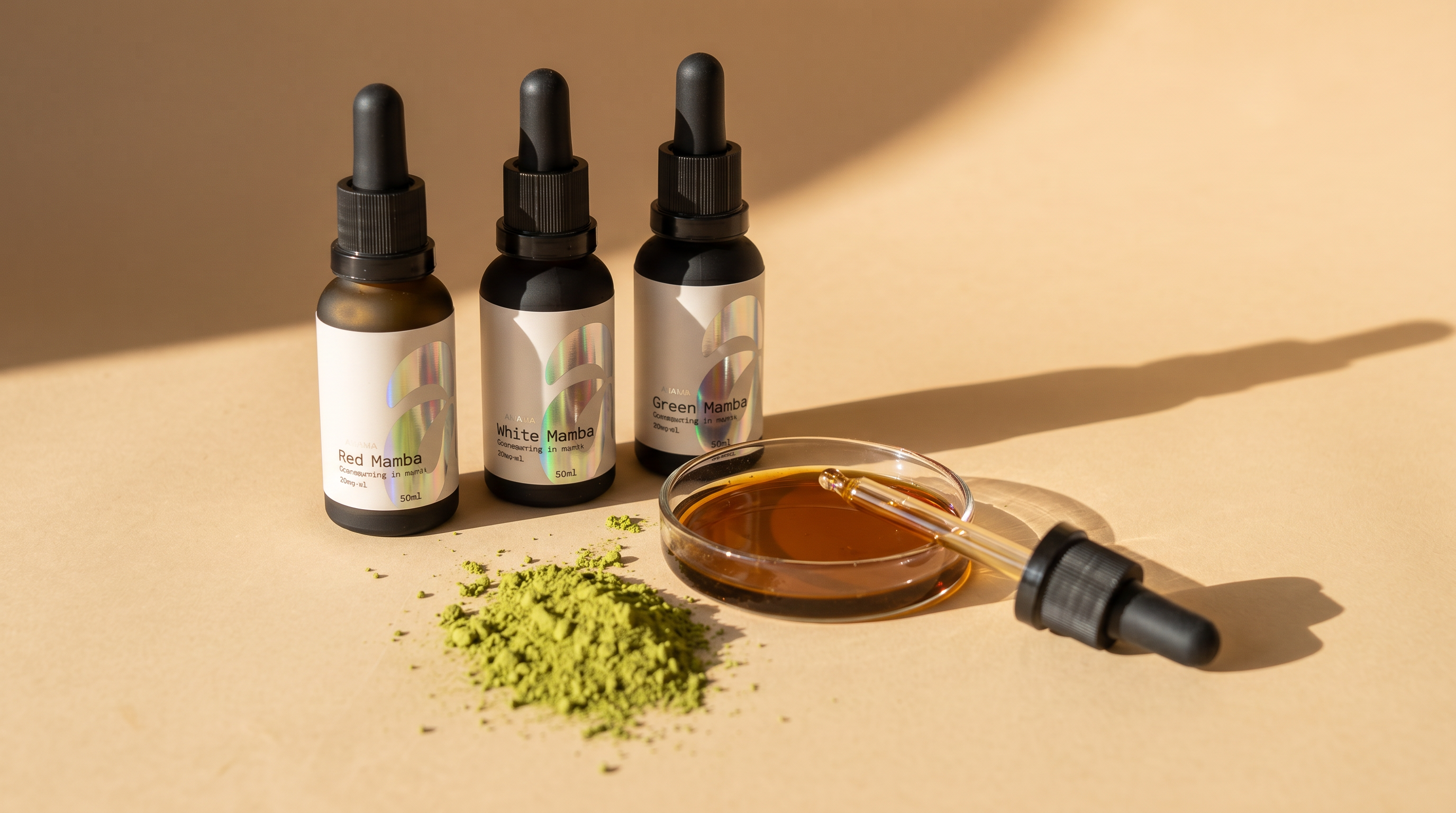
This article is part of the amama Kratom Guide. While the main guide covers botany, effect profile and legal status, this one focuses on a specific product form: the liquid extract. Extracts are more concentrated than leaf powder and are aimed at users who are already familiar with Mitragyna speciosa.
TL;DR
- A kratom extract is a concentrate of the alkaloids from the leaf of Mitragyna speciosa — significantly higher alkaloid density per milliliter than powder per gram.
- Liquid extracts are produced via water or alcohol extraction and subsequently concentrated; the goal is a consistent alkaloid profile.
- amama's Mamba line (Green, White, Red) comes from partner farms in Kalimantan (Borneo) and is lab-tested batch by batch (alkaloids, pesticides, heavy metals, microbiology).
- Extracts are not suitable for beginners. They are appropriate for experienced users who prefer precise, compact portions.
- Kratom is legal in Germany (not listed under the BtMG or NpSG). This does not release one from responsible use — especially with extracts.
| Botanical name | Mitragyna speciosa (Korthals, 1839) |
| Plant family | Rubiaceae (coffee family) |
| Origin | Southeast Asia — Thailand, Malaysia, Indonesia (Borneo) |
| Primary alkaloids | Mitragynine (~66 %), 7-Hydroxymitragynine (~2 %) |
| Available forms | Powder, capsules, liquid extract |
| Legal status (DE) | Legal — not listed in BtMG or NpSG |
What is a kratom extract?
A kratom extract is a concentrate of the alkaloids contained in the leaf. The dried leaf contains approximately 0.5–1.5% total alkaloids, with mitragynine making up the main share (~66%) and 7-hydroxymitragynine, speciociliatine, speciogynine and paynantheine present in smaller amounts (More on mitragynine).

Mitragynine
In an extract, this alkaloid fraction is separated from the plant ballast — cellulose, fibers, waxes — and concentrated. The result: a liquid or resin containing significantly more active molecules per unit volume than the raw material.
"Concentrated" in practice means: a few drops or a few milliliters of a liquid extract can correspond to a portion of powder — depending on standardization and product. This makes application more compact but also requires more precision.

Kratom leaf detail — Mitragyna speciosa
Wikimedia Commons · CC BY 3.0
How extracts are made
There are two common extraction methods:
Water extraction (decoction)
The leaf powder is boiled or steeped in water — often slightly acidified with lemon juice or citric acid, since the alkaloids as salts are more water-soluble. The liquid is filtered, the plant residue removed, and the filtrate gently evaporated. Traditionally, this corresponds to the tea approach in Southeast Asia, only further reduced.
Alcohol extraction (tincture principle)
Ethanol efficiently dissolves both polar and non-polar alkaloids. After maceration, the mixture is filtered and the alcohol is removed under reduced pressure. The result is a concentrated extract, which is then often processed with water and vegetable glycerin into the final formulation.
Standardization
The goal of reputable production is for each batch to be comparable in alkaloid content. This is achieved through:
- Selection of raw material from the same regions and harvest windows
- HPLC measurement of mitragynine content per batch
- Adjustment of the final concentration to a target value
Why the liquid format has advantages
- Consistency: with clean standardization, the alkaloid ratio per ml remains stable.
- Taste: the characteristically bitter powder flavor can be better masked in small volumes.
- Sublingual absorption: some of the alkaloids can be absorbed directly through the oral mucosa, which tends to accelerate onset.
- Travel compatibility: 30 ml vs. 150 g of powder — a practical difference.
Details on classical preparation methods can be found in the article on Kratom preparation.
Mamba Kratom Extract: amama's standard
The Mamba line was developed to offer customers at the Neukölln store and in the online shop a liquid extract with traceable origin and tested quality. Three points are central:
1. Direct sourcing from Kalimantan (Borneo). Mitragyna speciosa traditionally grows in the lowland forests of Southeast Asia; Indonesian Kalimantan is today the most important cultivation region. amama works with partner farms that gently dry the leaf and separate harvests by vein color (green, white, red) — the basis of the three Mamba variants (see also: Kratom strains).

Mitragyna speciosa in its native habitat in Nanga Embaloh Village, West Kalimantan (Borneo), Indonesia — the historical heartland of kratom cultivation and traditional use.
Wikimedia Commons · CC BY-SA 4.0

Mature Mitragyna speciosa (kratom) tree in natural habitat
Wikimedia Commons · CC BY 3.0
2. Lab testing of every batch. Tested are:
- Alkaloid profile (mitragynine, 7-hydroxymitragynine via HPLC)
- Pesticide residues
- Heavy metals (lead, cadmium, arsenic, mercury)
- Microbiology (total viable count, yeasts, molds, E. coli, salmonella)
Certificates of Analysis (COAs) are available on request.
3. Direct customer feedback. The physical store in Neukölln allows Bernard and the team to talk with experienced users, iterate on formulations and fine-tune batch by batch — an advantage that pure online retailers rarely have.

Green 'Mamba' Kratom Extract

White 'Mamba' Kratom Extract 30ml

Red 'Mamba' Kratom Extract
Extract vs. powder: when to use what?
| Criterion | Powder | Liquid extract (Mamba) |
|---|---|---|
| Entry level | Ideal for newcomers | For experienced users |
| Dosing | Gradual control | Precise, compact |
| Taste | Bitter, earthy | Concentrated, small amount |
| Onset | approx. 15–30 min | approx. 10–20 min (sublingual) |
| Portability | Practical, but bulky | Very compact (30 ml) |
| Price per portion | Cheaper | Higher, but less needed |
| Standardization | Varies by batch | Adjusted to target value |
For entry we generally recommend kratom powder — it allows finer dosing steps and better self-observation.
How do you use Mamba extract?
Sublingual application
A few drops under the tongue, hold for 30–60 seconds, then swallow. Some of the alkaloids are absorbed via the oral mucosa; the rest is absorbed gastrointestinally.
With juice or water
Citrus or ginger juices mask the bitter taste well. The acid slightly changes the absorption profile but is unproblematic.
Start low
Even experienced powder users should start with a very small amount the first time with extract and wait 45–60 minutes before re-dosing. The onset is faster and the concentration per volume is significantly higher than with powder.
Do not combine with alcohol
Both substances act on the central nervous system. From a harm-reduction perspective, the combination is clearly inadvisable, especially due to respiratory depression at higher doses. Also to be avoided: combinations with benzodiazepines, opioids, other sedating substances and — because of serotonergic overlap — with SSRIs/MAO inhibitors without medical consultation.
A detailed discussion of the effect profile can be found in the article on kratom effects.
Important notes for extracts
No starting with extracts. Anyone who has never used kratom should begin with leaf powder. The dose-response curve can be better understood there.
Tolerance builds faster. Due to the high alkaloid concentration, tolerance develops faster with regular extract use than with powder. That means: more needed for the same effect — a classic warning sign.
No daily long-term use. Surveys of long-term users (Grundmann 2017; Singh et al. 2014) show that daily high doses over extended periods can be associated with dependence development and withdrawal symptoms. Extracts accelerate this risk. Occasional, deliberate use with breaks is the more responsible model.
Harm reduction instead of denial. Honesty with oneself about frequency and occasion is more important than any outside recommendation.
Back to the guide
- Kratom Guide (Pillar)
- Kratom Strains: Green, White, Red
- Kratom Effects and Pharmacology
- Kratom Preparation: Tea, Toss & Wash, Extract
- Legal Status in Germany


Sources
- Kruegel, A. C., & Grundmann, O. (2018). The medicinal chemistry and neuropharmacology of kratom: A preliminary discussion of a promising medicinal plant and analysis of its potential for abuse. Neuropharmacology, 134, 108–120.
- Grundmann, O. (2017). Patterns of kratom use and health impact in the US — Results from an online survey. Drug and Alcohol Dependence, 176, 63–70.
- Singh, D., Müller, C. P., & Vicknasingam, B. K. (2014). Kratom (Mitragyna speciosa) dependence, withdrawal symptoms and craving in regular users. Drug and Alcohol Dependence, 139, 132–137.
- Hassan, Z. et al. (2013). From Kratom to mitragynine and its derivatives: Physiological and behavioural effects. Neuroscience & Biobehavioral Reviews, 37(2), 138–151.
- WHO Expert Committee on Drug Dependence (2021). Pre-Review Report: Kratom (Mitragyna speciosa), mitragynine and 7-hydroxymitragynine. 44th Meeting, Geneva.
This article serves exclusively for scientific-ethnobotanical information and does not constitute medical advice, therapeutic recommendation or usage instructions. Kratom is not listed under the BtMG or NpSG in Germany and is currently legal; this does not release one from personal due diligence. Additional note on extracts: Liquid extracts are expressly intended for experienced users. Anyone trying kratom for the first time should begin with leaf powder and seek medical advice in case of pre-existing conditions or chronic medications. Do not use during pregnancy, breastfeeding or in combination with other centrally acting substances. Last updated: 2025.
Further Reading
- Kratom Guide: The Complete Plant Profile
- Kratom Strains: Red, Green & White Explained
- Kratom Legal Status in Germany & Europe 2026
→ Mitragynine Compound Profile — chemistry & pharmacology