

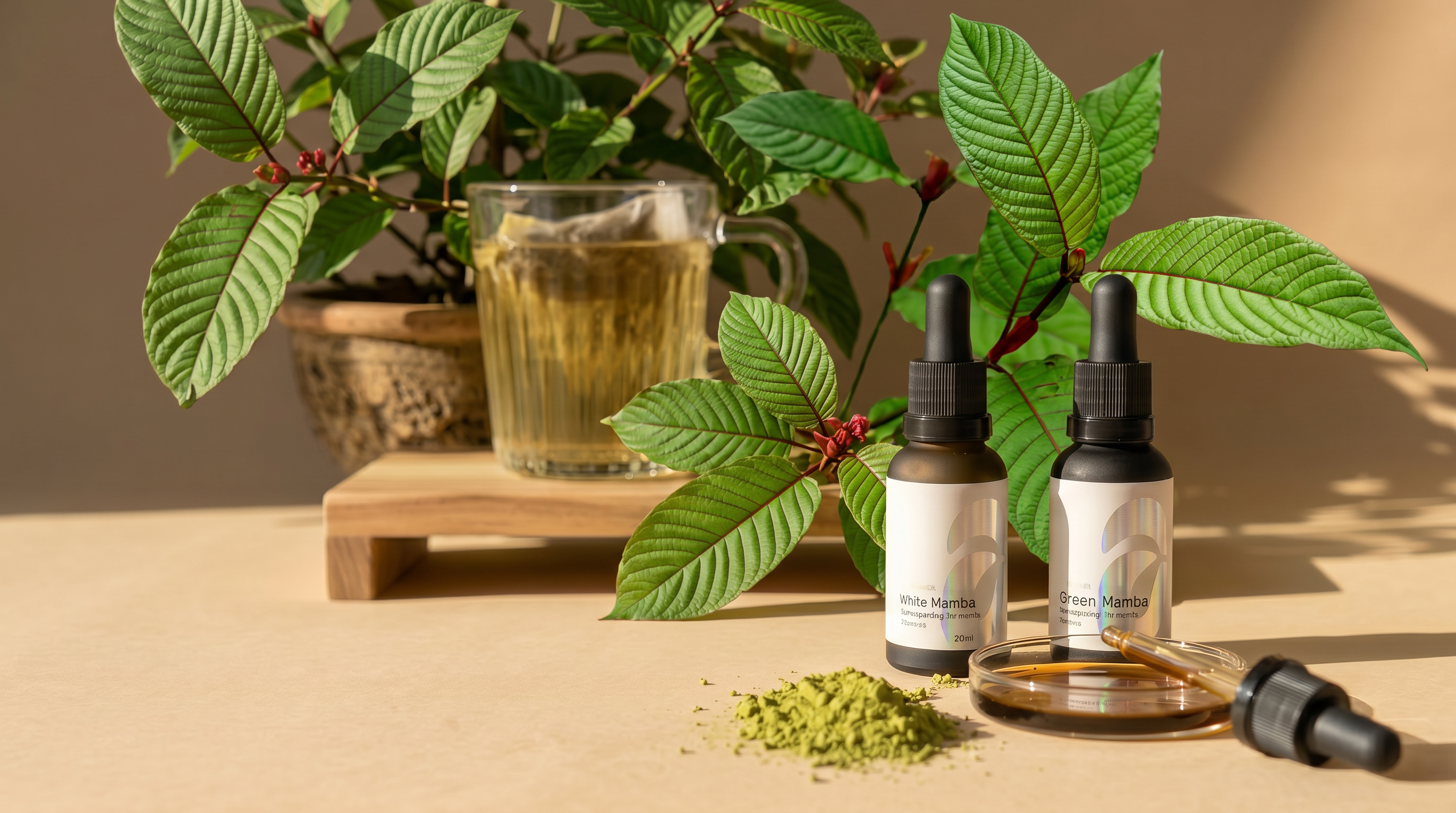
This article is Part 5 of our seven-part Kratom Guide. It focuses on the practical methods by which Mitragyna speciosa has been prepared traditionally and is prepared today — from classic tea brewing to sublingual use of liquid extracts.
TL;DR
- Tea is the recommended entry method — gentle, controllable, traditional.
- Water temperature 80–90 °C, do not boil: high heat can degrade alkaloids such as mitragynine.
- Toss & Wash is fast but flavour-challenging and less suitable for beginners.
- Yogurt or shake effectively mask the bitter taste in everyday use.
- Liquid extracts (e.g. Mamba) are intended for experienced users and act more quickly sublingually.
| Botanical name | Mitragyna speciosa (Korthals, 1839) |
| Plant family | Rubiaceae (coffee family) |
| Origin | Southeast Asia — Thailand, Malaysia, Indonesia (Borneo) |
| Primary alkaloids | Mitragynine (~66 %), 7-Hydroxymitragynine (~2 %) |
| Available forms | Powder, capsules, liquid extract |
| Legal status (DE) | Legal — not listed in BtMG or NpSG |

Kratom leaf detail — Mitragyna speciosa
Wikimedia Commons · CC BY 3.0
Kratom as Tea (recommended for beginners)
Tea preparation is the most traditional and at the same time most controlled way of using kratom. In the regions of origin in Southeast Asia — Thailand, Malaysia and Indonesian Kalimantan — Mitragyna speciosa has been consumed as an infusion for centuries (Hassan et al., 2013).
Step-by-step instructions
- Measure the powder. Start with a low amount. The exact dosage depends on strain, individual sensitivity and experience — when in doubt, use less (see Kratom Effects).
- Heat water — but do not boil. The ideal temperature is 80–90 °C. Boiling water can thermally stress sensitive alkaloids. Using a thermometer is the safest bet; alternatively, switch off the kettle just before the boiling point or let it stand for 1–2 minutes after boiling.
- Add lemon juice (optional). A squeeze of lemon lowers the pH. Citric acid can support the extraction of the alkaloids, as these dissolve better in an acidic medium.
- Steep for 15–20 minutes. Stir occasionally. Longer steeping times extract more alkaloids but also intensify the bitter taste.
- Strain. A fine sieve, a coffee filter or a cotton tea bag separates the powder from the infusion.
- Season to taste. Honey, ginger, cinnamon or a piece of lemon zest soften the characteristic bitterness.
Why tea makes sense for beginners
- Slow onset (20–30 minutes) — the body has time to respond.
- Easy to dose via the amount of powder infused.
- Gentler on the stomach than swallowing powder directly.
- Ritual character: The preparation itself creates mindfulness in handling the plant.
Toss & Wash
With this method, measured kratom powder is placed directly on the tongue and washed down with a liquid (water, juice).
Advantages:
- No preparation time.
- Faster onset than with tea (approx. 15–25 minutes).
- No reduction through infusion — the entire alkaloid profile is preserved.
Disadvantages:
- The taste is intensely bitter and earthy.
- The gag reflex may be triggered.
- Less precise control than with tea.
Tips for minimising the gag reflex
- Take the powder in small portions (e.g. two half portions).
- Have a sip of the rinsing liquid in your mouth beforehand, then add the powder.
- Cold liquids make swallowing easier.
- Breathe deeply through the nose, not through the mouth.
For the first contact with kratom, this method is not recommended.
Kratom in Yogurt or a Shake
Stirring it into yogurt or a protein shake is one of the most practical everyday methods, especially for regular users who want to mask the taste.
- Full-fat yogurt is recommended — fats may support the uptake of fat-soluble plant compounds.
- Banana, cocoa or nut butter additionally cover the bitterness.
- No citrus juices in combination with the yogurt method: the acid can cause milk protein to curdle (unfavourable visually and in taste).
- Stir well so that no lumps form.
Absorption is somewhat slower than with tea or Toss & Wash because gastric emptying is delayed by the solid food component — this can result in more even kinetics.
Kratom Extract (Mamba): Sublingual Use
Liquid extracts such as the Mamba range are concentrated extractions and are aimed at experienced users.
Application
- Place a measured portion (use the pipette or dosing cap) under the tongue.
- Hold for 30–60 seconds — the mucous membrane under the tongue is well supplied with blood, so that some of the alkaloids can be absorbed directly.
- Then swallow.
Why sublingually?
Sublingual absorption partially bypasses the first-pass metabolism in the liver. The subjective onset of effects is often described by users as 10–20 minutes — faster than with tea or Toss & Wash.
Alternative: In juice
Those who cannot tolerate the taste sublingually can add the portion to a small amount of juice or water and drink it. The onset is then somewhat slower, since absorption takes place predominantly in the gastrointestinal tract.
Extracts are intended for experienced users, because the alkaloid concentration is significantly higher than with leaf powder. For beginners we recommend classic tea made from kratom powder.
Traditional Methods from Southeast Asia
In Malaysia, southern Thailand and Borneo, Mitragyna speciosa has been part of village life for generations (Singh et al., 2014; Vicknasingam et al., 2010).
Chewing fresh leaves
Agricultural workers in southern Thailand and Kedah (Malaysia) traditionally chew fresh kratom leaves — usually after removing the midrib. This method does not work with dried powder: fresh leaves contain sap that enables chewing, whereas dry powder just clumps up in the mouth.
Village tea in Kalimantan
In Borneo, whole leaves are simmered in water for hours, strained and often combined with other herbs. These teas are referred to as "ketum" or "biak-biak" and are drunk in social contexts — during communal work, in the fields, at gatherings.
These preparations are more than method: they are part of a cultural fabric in which plant, work and community belong together. More on the origin of our leaves can be found in the section on kratom strains.

Mitragyna speciosa in its native habitat in Nanga Embaloh Village, West Kalimantan (Borneo), Indonesia — the historical heartland of kratom cultivation and traditional use.
Wikimedia Commons · CC BY-SA 4.0

Mature Mitragyna speciosa (kratom) tree in natural habitat
Wikimedia Commons · CC BY 3.0
Comparison Table of Preparation Methods
| Method | Difficulty | Onset | Recommended for |
|---|---|---|---|
| Tea | Easy | 20–30 min | Beginners |
| Toss & Wash | Medium | 15–25 min | Experienced |
| In yogurt | Easy | 20–35 min | Everyday use |
| Liquid extract | Easy | 10–20 min | Experienced |
| Chewing fresh leaf | Traditional | 10–15 min | — |
The onset times given are empirical values from user surveys (Grundmann, 2017) and can vary considerably from person to person.
Storage and Shelf Life
The quality of kratom stands and falls with storage. Mitragynine and the accompanying alkaloids are sensitive to light, heat, oxygen and moisture.

Mitragynine
Basic rules
- Store airtight (original packaging or a preserving jar).
- Store in the dark — UV light accelerates alkaloid degradation.
- Cool and dry — ideally at room temperature, not in the bathroom or above the stove.
- In very humid climates, a food-grade desiccant (silica gel) in the container can be useful.
Shelf life
- Kratom powder generally remains qualitatively stable for 1–3 years when stored airtight and in the dark. Colour (rich green to olive green) and aroma are good indicators — a musty or stale smell indicates loss of quality.
- Liquid extracts (Mamba) are also stable over longer periods when stored properly; the exact shelf life is stated on the label.
amama's packaging is designed for light protection and airtightness in order to preserve alkaloid stability over the storage period.

Green 'Mamba' Kratom Extract
Back to the Guide
- Main article: Kratom: The Complete Guide
- Understanding strains: Red, Green, White — Kratom Strains Compared
- Effects and pharmacology: Kratom Effects
- Concentrated extractions: Kratom Extract Explained


Sources
- Grundmann, O. (2017). Patterns of Kratom use and health impact in the US — Results from an online survey. Drug and Alcohol Dependence, 176, 63–70.
- Hassan, Z., Muzaimi, M., Navaratnam, V., et al. (2013). From Kratom to mitragynine and its derivatives: Physiological and behavioural effects related to use, abuse, and addiction. Neuroscience & Biobehavioral Reviews, 37(2), 138–151.
- Singh, D., Müller, C. P., & Vicknasingam, B. K. (2014). Kratom (Mitragyna speciosa) dependence, withdrawal symptoms and craving in regular users. Drug and Alcohol Dependence, 139, 132–137.
- Vicknasingam, B., Narayanan, S., Beng, G. T., & Mansor, S. M. (2010). The informal use of ketum (Mitragyna speciosa) for opioid withdrawal in the northern states of peninsular Malaysia and implications for drug substitution therapy. International Journal of Drug Policy, 21(4), 283–288.
- World Health Organization (2021). Expert Committee on Drug Dependence — Critical Review Report: Kratom (Mitragyna speciosa), mitragynine, and 7-hydroxymitragynine. Geneva: WHO.
As of: 2025. This article is intended solely for botanical and cultural information. It does not constitute medical advice and is not an invitation to consume. Kratom is legal in Germany (not listed in the BtMG or NpSG), but is regulated differently in other countries. Persons with pre-existing conditions, pregnant or breastfeeding women, and persons taking medication should seek medical advice before any use of traditional plants.
Further Reading
- Kratom Guide: The Complete Plant Profile
- Kratom Effects: Alkaloids & Mechanism of Action
- Kratom Strains: Red, Green & White Explained
→ Mitragynine Compound Profile — chemistry & pharmacology