

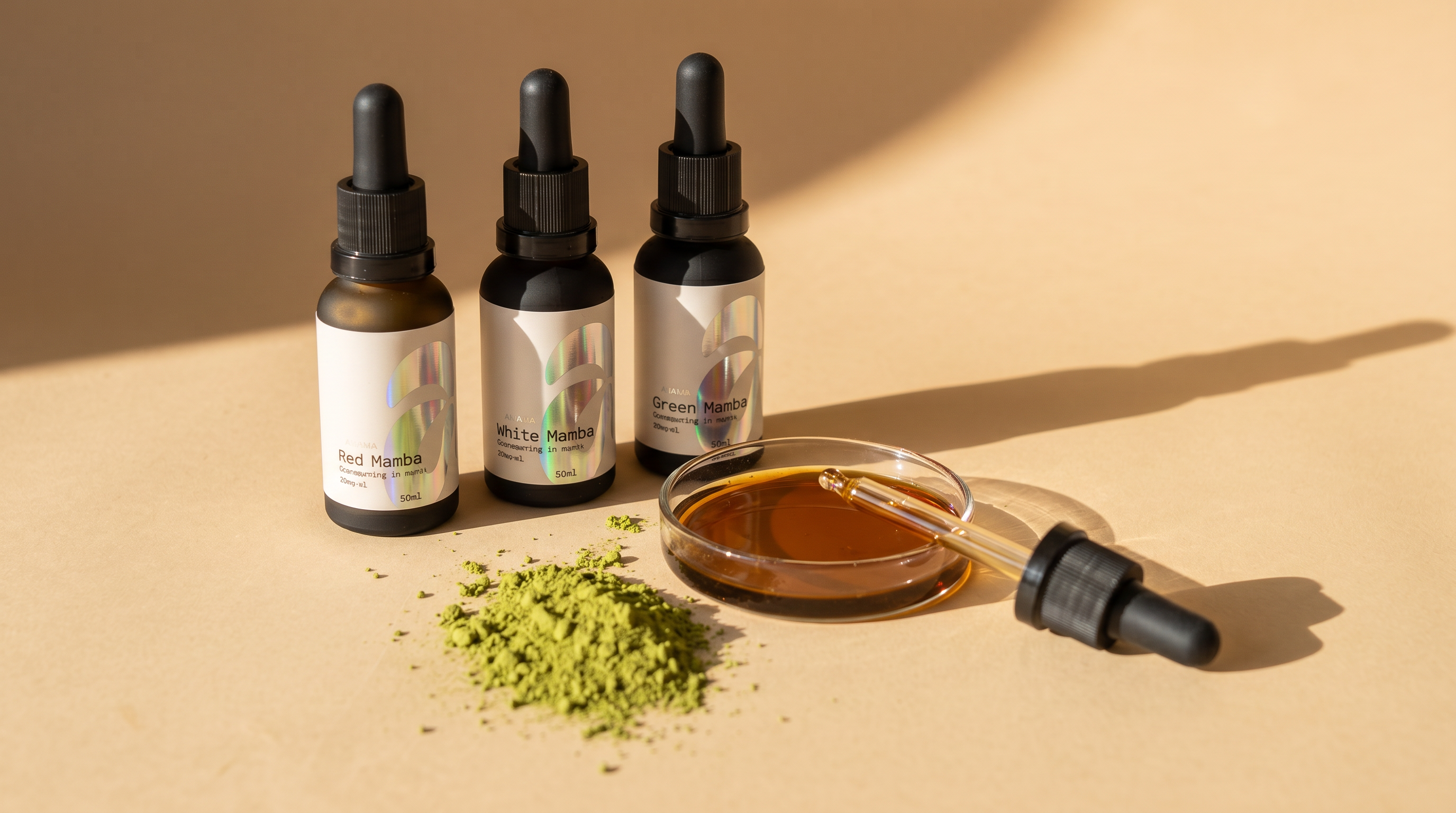
This article is part of our comprehensive kratom guide and examines the common classification of Mitragyna speciosa leaves by vein color as well as the resulting product categories — from traditional powder to modern liquid extracts.
TL;DR
- The classification into red, green and white vein refers to the color of the leaf's central midrib and is of traditional origin.
- Gold and yellow varieties result from special drying or fermentation processes, not from separate plants.
- Users report: Red = relaxing, Green = balanced, White = activating — not yet conclusively proven scientifically.
- Extracts concentrate the alkaloids; faster onset, suitable only for experienced users.
- Regional names like Maeng Da or Borneo are often marketing, not botanical categorization.
| Botanical name | Mitragyna speciosa (Korthals, 1839) |
| Plant family | Rubiaceae (coffee family) |
| Origin | Southeast Asia — Thailand, Malaysia, Indonesia (Borneo) |
| Primary alkaloids | Mitragynine (~66 %), 7-Hydroxymitragynine (~2 %) |
| Available forms | Powder, capsules, liquid extract |
| Legal status (DE) | Legal — not listed in BtMG or NpSG |

Kratom leaf detail — Mitragyna speciosa
Wikimedia Commons · CC BY 3.0
What does "vein color" mean?
Vein color refers to the color of the midrib and fine leaf veins of a freshly picked kratom leaf. Traditionally, three basic types are distinguished: red, green and white. This classification comes from the growing regions of Southeast Asia — particularly Kalimantan (Borneo), Sumatra and the Malaysian regions — and has been used by local farmers over generations to sort leaves according to perceived effect profiles.
Whether vein color is actually genetically determined, arises from the maturity stage at harvest, or represents a combination of both factors is not conclusively clarified scientifically. Phytochemical analyses (among others Hassan et al. 2013) show that alkaloid ratios can differ between chemotypes and maturity stages — however, a strict correlation between vein color and a specific alkaloid pattern has so far not been clearly demonstrated.
Gold and yellow varieties are not distinct plants, but the result of modified post-harvest processes: extended drying under UV light, controlled fermentation or blending different batches can alter the alkaloid profile and produce a different coloration of the dried powder.
The strains in detail
Red Vein
Red leaves mostly come from more mature plants and are sometimes additionally fermented. Analyses suggest that mitragynine remains the dominant alkaloid component, while the proportion of 7-hydroxymitragynine in red varieties tends to be higher.

Mitragynine
In user surveys (among others Grundmann 2017), users of red varieties more frequently report relaxing, physically heavier sensations — reasons why red strains are traditionally preferred for the late afternoon and evening.
amama offers the red type as a liquid concentrate:

Red 'Mamba' Kratom Extract
Green Vein
Green leaves are harvested at a medium maturity stage and show a balanced alkaloid spectrum. Users describe green strains as the most versatile type: neither strongly sedating nor strongly activating, with a slight mood lift and good suitability for daytime use.
Green vein is considered the most popular entry point for new users, as the profile is perceived as well-tolerated and moderate.

Green 'Mamba' Kratom Extract
White Vein
White vein is obtained from younger leaves. The alkaloid profile tends to show a higher proportion of speciociliatine and paynantheines relative to total mitragynine. Users report an activating, focusing profile traditionally used for morning and early daytime hours.

White 'Mamba' Kratom Extract 30ml
Gold/Yellow Vein
Gold and yellow varieties arise from extended drying processes, special fermentation or the deliberate blending of several vein colors. The result is a nuanced, milder profile that many users describe as balanced. These varieties are seasonal and not continuously available.
Extracts
Extracts are concentrated alkaloid fractions obtained through water or water-ethanol extraction from raw powder. They are characterized by a faster onset and significantly higher alkaloid concentrations per volume — accordingly, they are intended exclusively for experienced users.
You can find a detailed classification in our article on kratom extracts.
Large comparison table
| Strain | Alkaloid profile | Effect (user reports) | Best use | amama product |
|---|---|---|---|---|
| Red Vein | Mitragynine-emphasized, tendentially higher 7-OH content | Relaxing, body-heavy | Evening, relaxation | Red Mamba Extract |
| Green Vein | Balanced alkaloid profile | Balanced, slight mood lift | Daytime | Green Mamba Extract 30ml |
| White Vein | Higher speciociliatine/paynantheines content | Activating, focusing | Morning / afternoon | White Mamba Extract 30ml |
| Gold / Yellow | Altered profile through drying processes | Mild, balanced, nuanced | Flexible | Kratom powder 150g |
| Extract | Highly concentrated (liquid extract) | Stronger, faster onset | Experienced users | All Mamba extracts |
Which strain for me?
- If you're trying kratom for the first time — start with a green variety. It's considered balanced and is a good reference point to contextualize your own experience.
- If you want to wind down in the evening — choose a red strain. Users describe the profile as physically calming.
- If you're looking for clarity and focus in the morning — the white variety is traditionally used during the day.
- If you already have experience and prefer a compact format — liquid extracts offer short intake and faster onset.


Red 'Mamba' Kratom Extract
White 'Mamba' Kratom Extract 30ml
Regional origin and strains

Mitragyna speciosa in its native habitat in Nanga Embaloh Village, West Kalimantan (Borneo), Indonesia — the historical heartland of kratom cultivation and traditional use.
Wikimedia Commons · CC BY-SA 4.0

Mature Mitragyna speciosa (kratom) tree in natural habitat
Wikimedia Commons · CC BY 3.0
Names like Maeng Da, Bali, Borneo, Thai or Sumatra appear on many packages — but should be read with caution:
- Maeng Da roughly translates to "pimp grade" or "high-quality" in Thai — it's a marketing term, not a botanical category. Maeng Da can be red, green or white.
- Bali historically refers to the export port, not the cultivation location. Many "Bali" kratoms actually come from Kalimantan (Borneo, Indonesia) — the world's most important cultivation area.
- Borneo is the most botanically consistent origin indication, as a large portion of globally traded kratom grows there.
- Thai is often used, although commercial cultivation in Thailand has been historically restricted — many "Thai" products are chemotypes based on Thai varieties but cultivated in Indonesia.
For consumers, therefore, the combination of vein color + country of origin + supplier transparency is more meaningful than a regional trade name alone. amama sources raw material from Kalimantan.
Back to the guide
- Kratom Guide (Pillar)
- Kratom Effects and Pharmacology
- Kratom Extracts in Detail
- Kratom Preparation: Tea, Powder, Extract
Sources
- Hassan, Z., Muzaimi, M., Navaratnam, V., Yusoff, N. H. M., Suhaimi, F. W., Vadivelu, R., ... & Müller, C. P. (2013). From Kratom to mitragynine and its derivatives: physiological and behavioural effects related to use, abuse, and addiction. Neuroscience & Biobehavioral Reviews, 37(2), 138–151.
- Grundmann, O. (2017). Patterns of Kratom use and health impact in the US — Results from an online survey. Drug and Alcohol Dependence, 176, 63–70.
- Singh, D., Narayanan, S., & Vicknasingam, B. (2016). Traditional and non-traditional uses of Mitragynine (Kratom): A survey of the literature. Brain Research Bulletin, 126, 41–46.
- Kruegel, A. C., & Grundmann, O. (2018). The medicinal chemistry and neuropharmacology of kratom: A preliminary discussion of a promising medicinal plant and analysis of its potential for abuse. Neuropharmacology, 134, 108–120.
- World Health Organization, Expert Committee on Drug Dependence (2021). Pre-Review Report: Kratom (Mitragyna speciosa), mitragynine, and 7-hydroxymitragynine. WHO, Geneva.
As of: 2025. This article is for informational and educational purposes only and does not constitute medical advice. Kratom (Mitragyna speciosa) is not listed in Germany's Narcotics Act (BtMG) or the New Psychoactive Substances Act (NpSG) and is legal. No healing, alleviation or therapeutic promises are made. For health-related questions, please consult a qualified medical professional.
Further Reading
- Kratom Guide: The Complete Plant Profile
- Kratom Effects: Alkaloids & Mechanism of Action
- Kratom Extract: Potency, Types & Dosing
- Kratom Preparation: Methods & Best Practices
→ Mitragynine Compound Profile — chemistry & pharmacology