

TL;DR
- Kratom (Mitragyna speciosa) is a tropical tree in the coffee family (Rubiaceae) whose leaves have been used traditionally in Southeast Asia for centuries.
- In Germany, kratom is legal — not listed in the BtMG (Schedules I–III) nor in the NpSG.
- The main strains are distinguished by leaf vein color: Red, Green, White, Gold — each with its own alkaloid profile.
- Liquid extracts concentrate the alkaloids (especially mitragynine) and differ from leaf powder in format and bioavailability.
- amama sources its products directly from Kalimantan (Indonesian Borneo) and has every batch lab-tested (pesticides, heavy metals, microbiology).
- Do not combine with other centrally acting substances, especially opioids or sedatives — consult a doctor if you have health concerns.
| Botanical name | Mitragyna speciosa (Korthals, 1839) |
| Plant family | Rubiaceae (coffee family) |
| Origin | Southeast Asia — Thailand, Malaysia, Indonesia (Borneo) |
| Primary alkaloids | Mitragynine (~66 %), 7-Hydroxymitragynine (~2 %) |
| Available forms | Powder, capsules, liquid extract |
| Legal status (DE) | Legal — not listed in BtMG or NpSG |
The first scientific description of Mitragyna speciosa is owed to the Dutch botanist Pieter Willem Korthals, who documented the species in 1839 during an expedition in the Malay Archipelago. His detailed plate still shows the plant's typical leaf and flower morphology today.

Original botanical plate from Korthals' 1839 scientific description of Mitragyna speciosa — the first formal classification of the kratom tree.
Dutch Colonial Botanical Survey, Netherlands East Indies · Public Domain
What is Kratom?
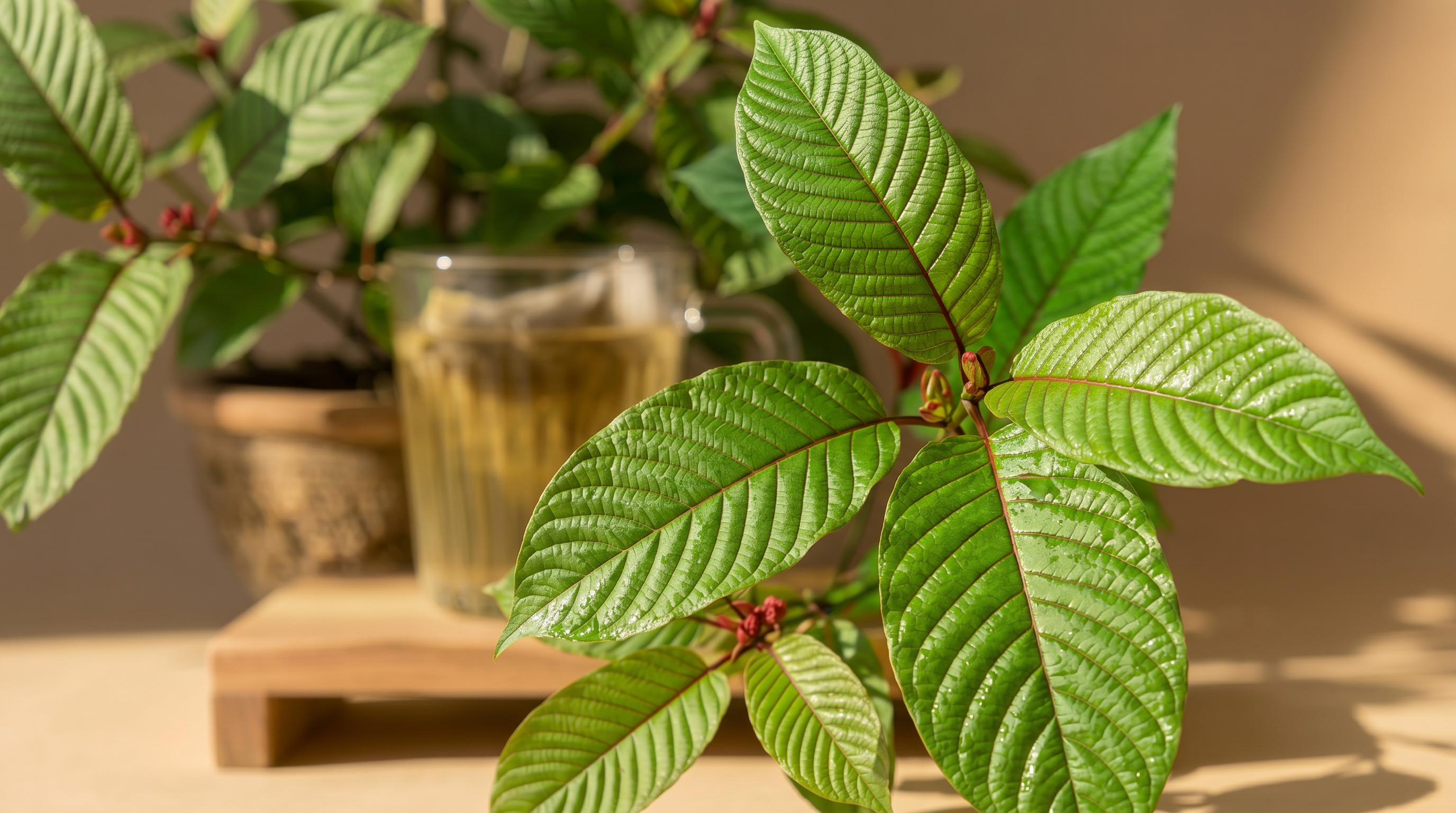
Kratom is the common name for Mitragyna speciosa (Korthals, 1839) — an evergreen tree in the Rubiaceae family (madder family), making it botanically closely related to the coffee shrub. In the wild, the tree reaches a height of 4 to 16 meters, has large, ovate-elliptic leaves with striking vein patterns, and bears spherical yellow inflorescences.
Shop kratom at amama: Browse our Kratom collection → — Red, Green & White vein, lab-tested with COA.
The plant is native to Southeast Asia, particularly Thailand, Malaysia, Indonesia (Sumatra, Borneo), Myanmar, and Papua New Guinea. Traditionally, the leaves bear regional names:
- biak-biak (Malaysia)
- ketum (Malaysia, southern Thailand)
- kakuam (central Thailand)

Kratom leaf detail — Mitragyna speciosa
Wikimedia Commons · CC BY 3.0
Traditional use is well documented ethnobotanically. Malaysian and Thai field workers chewed fresh kratom leaves during work over generations, or brewed them into a slightly bitter tea — often in rural regions with physically demanding agriculture. Singh et al. (2014) described in a field study among Malaysian long-term users that the leaves were embedded in the cultural context as an endurance aid and in social use.
An important distinction: the traditional use of fresh leaves differs considerably from modern consumption of dried powder or highly concentrated extracts. Fresh leaves contain lower alkaloid concentrations, and the cultural framework limited the nature and frequency of use.
Origin and Cultivation

Mitragyna speciosa in its native habitat in Nanga Embaloh Village, West Kalimantan (Borneo), Indonesia — the historical heartland of kratom cultivation and traditional use.
Wikimedia Commons · CC BY-SA 4.0

Mature Mitragyna speciosa (kratom) tree in natural habitat
Wikimedia Commons · CC BY 3.0
Kalimantan — the Indonesian part of the island of Borneo — is today considered the world's central cultivation area for high-quality kratom. The combination of tropical rain climate, volcanic soil, and high humidity favors pronounced alkaloid production in the leaves, with mitragynine concentrations in Borneo samples regularly coming out higher than in comparison samples from other regions.

Mitragynine
Thailand
Kratom was banned in Thailand in 1943 (Kratom Act), at the time primarily for economic policy reasons: traditional use competed with state-taxed opium revenues. Not until August 2021 was kratom decriminalized again in Thailand — a culturally significant step toward rehabilitating a plant with centuries of local history.
Malaysia
In Malaysia, ketum remains regulated, though traditional use in rural communities is still alive and scientifically documented (Vicknasingam et al. 2010; Singh et al. 2014).
amama's Sources
amama sources its kratom through established partner farms in Kalimantan, where the leaves are harvested at maturity, shade-dried, and sorted by vein color. Every batch undergoes laboratory analysis before import.
The Active Compounds at a Glance
Kratom contains over 40 identified alkaloids, but only a few contribute substantially to the pharmacological profile:
| Alkaloid | Share of alkaloid fraction | Characteristic |
|---|---|---|
| Mitragynine | ~66% | Dominant alkaloid, partial μ-opioid receptor agonist with G-protein bias |
| 7-Hydroxymitragynine | ~2% | Small share, significantly higher receptor affinity |
| Speciociliatine | ~1% | Stereoisomer of mitragynine |
| Speciogynine | ~7% | Structural relative, lower activity |
| Paynantheine | ~9% | Secondary alkaloid with moderate activity |
The pharmacologically decisive mechanism is the partial agonistic activity at the μ-opioid receptor. Unlike classical full opioid agonists, mitragynine shows a G-protein signaling pathway preference (GPCR bias) and recruits β-arrestin-2 significantly more weakly in preclinical studies — a signaling pathway associated with the side effects of classical opioids (Kruegel et al., Váradi et al., preclinical work). Additionally, adrenergic (α2) and serotonergic (5-HT) activities have been described.
Those who wish to delve deeper into the molecular foundations can find a detailed account at Kratom & Research as well as in the monograph article on Mitragynine.
Kratom Strains Overview
The classification into "Red," "Green," and "White" refers to the color of the leaf midrib at harvest and correlates roughly with differences in ripeness and drying — and thus with the alkaloid ratio.
| Strain | Profile | Typical use (reported) |
|---|---|---|
| Red Vein | Mature leaves, balanced to body-oriented profile | Evening use, relaxation |
| Green Vein | Medium maturity, balanced profile | Daytime companion, social occasions |
| White Vein | Young leaves, stimulating profile | Focus, morning use |
| Gold / Yellow | Special drying, mixed profile | Intermediate category, balanced |
| Extract | Concentrated alkaloid fraction (liquid/paste) | Sublingual use, reduced volume |
A detailed strain comparison including sensory and alkaloid-analytical differences can be found at Kratom Strain Comparison.
Effects: What Users Report
Users report in surveys and ethnobotanical surveys (Grundmann 2017, n=8,049) strain-dependent effects that vary. These reports are subjective and do not replace clinical data:
- Red Vein: more calming, physically relaxing (per user observation)
- Green Vein: balanced, socially facilitating
- White Vein: more stimulating, alertness-promoting
Duration of effect, influencing factors (stomach contents, individual metabolization via CYP2D6/CYP3A4), and a sober presentation of the available evidence can be found at Kratom Effects in Detail.
Preparation
Traditional and modern preparation forms include:
- Powder: Toss & Wash (powder into the mouth, washed down with water), brewed as tea, stirred into yogurt or smoothies.
- Liquid extract: sublingual application (under the tongue), higher alkaloid density, more precise portioning.
- Capsules: flavor-neutral alternative to powder.
Detailed preparation instructions — including traditional Southeast Asian tea preparation — can be found at Kratom Preparation.
Legal Status in Germany
Kratom is legal in Germany. Neither Mitragyna speciosa, nor mitragynine or 7-hydroxymitragynine are listed in:
- Narcotics Act (BtMG) — Schedules I, II, and III
- New Psychoactive Substances Act (NpSG) — Schedule
Thus possession, purchase, and sale are legally permissible for adults in Germany. Within the EU, the legal situation varies considerably: while Germany, the Netherlands, Spain, and Austria currently do not control kratom, countries such as Denmark, Finland, Latvia, Lithuania, Poland, Romania, and Sweden have regulated the substance.
Of international importance: the WHO Expert Committee on Drug Dependence (ECDD) conducted a pre-review of kratom in 2021 and decided not to recommend international scheduling — a meaningful signal toward evidence-based evaluation.
Full details, source references, and import notes can be found at Kratom & Legal Status in Germany.
amama & Kratom: Our Standards
amama has operated an online shop since 2021 and two physical locations in Berlin-Neukölln. Our kratom selection — in particular our in-house Mamba extract line — differs in several respects:
- Liquid extract format: highly concentrated alkaloid profile, sublingually applicable, reproducible portions.
- Direct sourcing from Indonesia: established partner farms in Kalimantan, no middlemen.
- Lab analysis of every batch: pesticide residues, heavy metals (lead, cadmium, mercury, arsenic), microbiological contamination (mold, Salmonella, coliforms).
- COAs on request: certificates of analysis are provided on customer request.
- Personal advice: In the Neukölln shop we speak with customers — a format that online retail cannot replace.


Green 'Mamba' Kratom Extract
Frequently Asked Questions
Is kratom legal in Germany?
Yes. Mitragyna speciosa and its main alkaloids mitragynine and 7-hydroxymitragynine are listed neither in the BtMG (Schedules I–III) nor in the NpSG. Purchase, possession, and sale to adults are legally permissible.
What is the difference between Red, Green, and White Vein?
The color designation refers to the leaf midrib at harvest. Red = mature leaves, Green = medium maturity, White = young leaves. The alkaloid ratios differ, which leads to the variously reported effect profiles.
What makes extracts different from powder?
Extracts concentrate the alkaloid fraction through solvent extraction. Liquid extracts are more highly dosed per volume, can be portioned more precisely, and applied sublingually. Details at Kratom Extract Explained.
Can kratom interact with medications?
Yes. Mitragynine is metabolized via CYP2D6 and CYP3A4 and can theoretically interact with numerous pharmaceuticals. In particular, the combination with other centrally acting substances (opioids, benzodiazepines, alcohol, sedating antihistamines) is to be avoided. If taking medication regularly, seek medical advice.
How long does the effect last?
User reports typically cite 2–5 hours for leaf powder, depending on strain, portion, stomach contents, and individual metabolization. Clinical pharmacokinetic data in humans are limited.
What is mitragynine?
Mitragynine is the dominant alkaloid in Mitragyna speciosa (~66% of the alkaloid fraction). It acts as a partial μ-opioid receptor agonist with G-protein bias and additionally shows adrenergic and serotonergic activity. See Mitragynine Monograph.
Can I order kratom by mail to Germany?
Yes, postal shipment is possible from countries without export restrictions or within the EU from retailer sources. Imports from third countries are subject to customs and consumer protection requirements.
Does amama ship from Berlin?
Yes. All orders are shipped from our warehouse in Berlin-Neukölln. Express delivery within Berlin is possible.
Is kratom addictive?
Long-term users report in surveys (Grundmann 2017, Singh et al. 2014) tolerance development and withdrawal symptoms upon abrupt discontinuation after regular use. The dependence potential is considered significantly lower than with classical opioids, but is present. Responsible use, breaks, and moderate application are advisable.
What is the difference between whole leaf and extract?
Whole-leaf powder contains the natural alkaloid spectrum in its original ratio. Extracts concentrate this spectrum — with correspondingly higher effect density per volume. Both formats have their justification; extracts require more experience in handling.
Further Articles
- Kratom Effects: What Studies and User Reports Show
- Kratom Strains: Red, Green, White, Gold Compared
- Kratom Extract: Production, Formats, Differences
- Kratom & Legal Status in Germany
- Kratom Preparation: Tea, Toss & Wash, Extract
- Kratom & Research: Pharmacology and Clinical Evidence
- Kratom vs. Kanna: Two Ethnobotanical Traditions Compared
Sources
- Grundmann, O. (2017). Patterns of Kratom use and health impact in the US — Results from an online survey. Drug and Alcohol Dependence, 176, 63–70. DOI: 10.1016/j.drugalcdep.2017.01.011
- Singh, D., Müller, C. P., Vicknasingam, B. K. (2014). Kratom (Mitragyna speciosa) dependence, withdrawal symptoms and craving in regular users. Drug and Alcohol Dependence, 139, 132–137.
- WHO Expert Committee on Drug Dependence (ECDD) (2021). Pre-Review Report: Kratom (Mitragyna speciosa), Mitragynine, and 7-Hydroxymitragynine. 44th Meeting, Geneva.
- Vicknasingam, B., Narayanan, S., Beng, G. T., Mansor, S. M. (2010). The informal use of ketum (Mitragyna speciosa) for opioid withdrawal in the northern states of peninsular Malaysia. International Journal of Drug Policy, 21(4), 283–288.
- Hassan, Z., Muzaimi, M., Navaratnam, V., et al. (2013). From Kratom to mitragynine and its derivatives: Physiological and behavioural effects related to use, abuse, and addiction. Neuroscience & Biobehavioral Reviews, 37(2), 138–151.
- Korthals, P. W. (1839). Observationes de Naucleis Indicis. First botanical description of Mitragyna speciosa.
- PubChem CID 9908089 — Mitragynine. National Center for Biotechnology Information. pubchem.ncbi.nlm.nih.gov
- Kruegel, A. C., Gassaway, M. M., Kapoor, A., et al. (2016). Synthetic and receptor signaling explorations of the mitragyna alkaloids. Journal of the American Chemical Society, 138(21), 6754–6764.
Last updated: April 2026 · Content reviewed by: Bernard — Co-Founder (Psychonaut) · This guide serves informational purposes only and does not replace medical advice. Kratom is not a medicinal product.
Further Reading
- Kratom Effects: Alkaloids & Mechanism of Action
- Kratom Strains: Red, Green & White Explained
- Kratom Extract: Potency, Types & Dosing
- Kratom Legal Status in Germany & Europe 2026
- Kratom Preparation: Methods & Best Practices
- Kratom Research: What the Science Says
- Kratom vs. Kanna: A Comparative Guide
→ Mitragynine Compound Profile — chemistry & pharmacology