

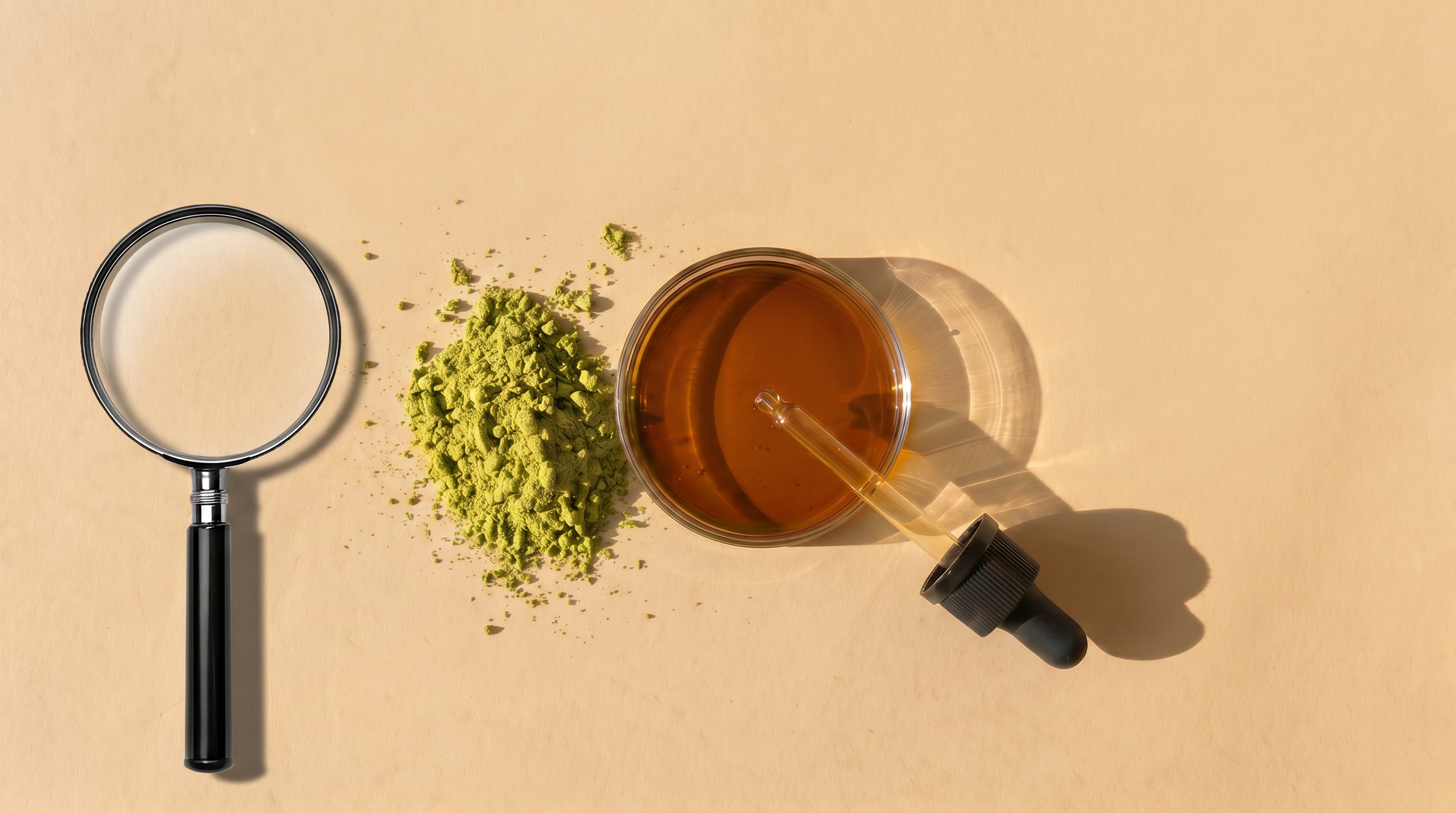
This article is Part 6 of 7 in our Kratom series and serves as the scientific anchor. For the overview, see the complete Kratom guide.
TL;DR
- Mitragynine is the main alkaloid (~66%) and a partial μ-opioid receptor agonist with GPCR bias — a signaling profile that differs from classical opioids.
- The 2021 WHO review recommended no international scheduling of kratom.
- Grundmann (2017) provided the largest user data collection to date with 8,049 respondents; Singh et al. (2014) documented long-term use in Malaysia.
- 7-Hydroxymitragynine is a minor alkaloid, but significantly more potent at the MOR than mitragynine.
- Knowledge gaps: long-term clinical studies, optimal dose ranges, interaction profiles.
- Publication numbers have been rising steadily since 2017 — kratom is an active research field.
| Botanical name | Mitragyna speciosa (Korthals, 1839) |
| Plant family | Rubiaceae (coffee family) |
| Origin | Southeast Asia — Thailand, Malaysia, Indonesia (Borneo) |
| Primary alkaloids | Mitragynine (~66 %), 7-Hydroxymitragynine (~2 %) |
| Available forms | Powder, capsules, liquid extract |
| Legal status (DE) | Legal — not listed in BtMG or NpSG |

Original botanical plate from Korthals' 1839 scientific description of Mitragyna speciosa — the first formal classification of the kratom tree.
Dutch Colonial Botanical Survey, Netherlands East Indies · Public Domain
The Main Alkaloids of Kratom
The leaf of Mitragyna speciosa contains over 40 identified alkaloids. Their composition determines the pharmacological profile of any given preparation. A detailed profile page on mitragynine can be found here.

Mitragynine
Mitragynine
Primary alkaloid, about 66% of the alkaloid fraction in the dried leaf. CAS number 4098-40-2, PubChem CID 3034396. In vitro and animal model studies characterize mitragynine as a partial agonist at the μ-opioid receptor (MOR) with GPCR bias — meaning it activates downstream signaling pathways differently from classical opioids (e.g., preferential G-protein activation over β-arrestin recruitment). This bias is discussed as a possible reason for a differing side effect profile.
Additionally, mitragynine shows activity at α2-adrenergic receptors and serotonin receptors (5-HT2A, 5-HT2C) in in vitro assays. Important caveat: these findings stem predominantly from in vitro and animal studies. Human clinical data are limited.
7-Hydroxymitragynine (7-OH-M)
Minor alkaloid, approximately 2% of total alkaloids, but significantly more potent at the MOR than mitragynine. 7-OH-M is also formed via metabolic conversion from mitragynine in vivo (CYP3A4-mediated). The ratio of mitragynine to 7-OH-M varies between preparations and extracts and may be a key determinant of the effect profile.
Speciociliatine, Speciogynine, Paynantheine
Secondary alkaloids with less well-studied pharmacology. Speciociliatine may act as a weak partial opioid agonist. Paynantheine and speciogynine contribute to the complex alkaloid fingerprint that distinguishes kratom from isolated mitragynine — a distinction often underestimated in pharmacological assessment.
Key Studies
Grundmann 2017 — The Largest User Survey
Grundmann, O. (2017). Patterns of kratom use and health impact in the US — results from an online survey. Drug and Alcohol Dependence, 176, 63–70. DOI: 10.1016/j.drugalcdep.2017.01.011
Online survey of 8,049 kratom users in the US — the most extensive self-reported data collection to date. Key findings:
- Majority reported use for pain management, mood support, and accompanying opioid withdrawal.
- Most respondents reported mild or no side effects.
- Physical dependence was reported by a minority of long-term, high-dose users.
Limitation: self-reported online survey, not a clinical study design — but nevertheless the most valuable snapshot of real-world usage patterns.
Singh et al. 2014 — Traditional Users in Malaysia
Singh, D., Müller, C. P., & Vicknasingam, B. K. (2014). Kratom (Mitragyna speciosa) dependence, withdrawal symptoms and craving in regular users. Drug and Alcohol Dependence, 139, 132–137. DOI: 10.1016/j.drugalcdep.2014.03.017
Study of traditional users in Malaysia — relevant because these individuals consume kratom in some cases for decades as a cultural practice. The authors document that dependence and withdrawal symptoms can occur with chronic high-dose use (daily, over years), though the withdrawal symptoms were generally less pronounced than with classical opioids.
Vicknasingam et al. 2010 — Ketum as Harm Reduction
Vicknasingam, B., Narayanan, S., Beng, G. T., & Mansor, S. M. (2010). The informal use of ketum (Mitragyna speciosa) for opioid withdrawal in the northern states of peninsular Malaysia. Journal of Ethnopharmacology, 127(2), 395–399. DOI: 10.1016/j.jep.2009.10.004
Ethnographic documentation of the traditional use of kratom tea (ketum) to manage opioid withdrawal symptoms in northern Malaysia. Important for understanding the cultural and harm-reduction context in which much of the evidence has emerged.
Prozialeck et al. 2012 — Pharmacological Review
Prozialeck, W. C., Jivan, J. K., & Bhatt, D. K. (2012). Pharmacology of kratom: an emerging botanical agent with stimulant, analgesic and opioid-like effects. Journal of the American Osteopathic Association, 112(12), 792–799.
Foundational pharmacological review article covering alkaloid mechanisms, traditional use, and open clinical questions. Frequently cited as an entry-level reference.
Kruegel & Grundmann 2018 — Modern Receptor Characterization
Kruegel, A. C., & Grundmann, O. (2018). The medicinal chemistry and neuropharmacology of kratom: A preliminary discussion of a promising medicinal plant and analysis of its potential for abuse. Neuropharmacology, 134 (Part A), 108–120. DOI: 10.1016/j.neuropharm.2017.08.026
Detailed analysis of receptor pharmacology, including discussion of GPCR bias and its clinical implications.
The 2021 WHO Review: A Significant Outcome
The WHO Expert Committee on Drug Dependence (ECDD) conducted a pre-review on kratom at its 44th meeting in 2021. The outcome:
The committee recommended not to proceed to a critical review and not to schedule kratom internationally.
This is a significant science-policy outcome: kratom remains unregulated at the UN level, and the German legal situation (not listed under the BtMG or NpSG) is consistent with this international position. More on the legal context in our article on the legal situation in Germany.
What this does not mean: It is not a recommendation or endorsement. The WHO explicitly noted that more research is needed — particularly on dependence potential, vulnerable populations, and clinical safety.
Current Research Landscape
The number of peer-reviewed publications on kratom has increased markedly between 2017 and 2025. Key research groups:
- University of Florida (Dr. Oliver Grundmann, Dr. Christopher McCurdy): ongoing pharmacological and clinical surveys.
- Johns Hopkins University (Dr. Albert Garcia-Romeu and colleagues): publications on usage patterns and dependence.
- University of Rochester, Columbia University: mechanistic work on GPCR bias and structure-activity relationships.
- Universiti Sains Malaysia (Dr. Darshan Singh): ethnopharmacological and long-term use studies.
What We Don't Yet Know
An honest overview of the evidence gaps:
| Area | Status |
|---|---|
| Long-term clinical studies in humans | largely missing |
| Optimal dose ranges for potential applications | not established |
| Interactions with other substances (CYP interactions) | limited investigation |
| Hepatotoxicity | case reports exist, causality contested, rare |
| Safety in pregnancy/lactation | not known, use is explicitly not recommended |
| Pharmacokinetics in humans | partially characterized, incomplete |
The research situation on kratom is active, but far from what could be called complete. This is the honest state of affairs.

Back to the Guide
- Kratom Guide (Pillar)
- Kratom Effects in Detail
- Kratom Legal Situation Germany
- Mitragynine — Substance Profile
Sources (complete)
- Korthals, P. W. (1839). Observationes de Nauclearum Indicarum. First description of Mitragyna speciosa, Dutch East Indies.
- Prozialeck, W. C., Jivan, J. K., & Bhatt, D. K. (2012). Pharmacology of kratom: an emerging botanical agent with stimulant, analgesic and opioid-like effects. Journal of the American Osteopathic Association, 112(12), 792–799.
- Hassan, Z., Muzaimi, M., Navaratnam, V., et al. (2013). From Kratom to mitragynine and its derivatives: Physiological and behavioural effects related to use, abuse, and addiction. Neuroscience & Biobehavioral Reviews, 37(2), 138–151. DOI: 10.1016/j.neubiorev.2012.11.012
- Singh, D., Müller, C. P., & Vicknasingam, B. K. (2014). Kratom (Mitragyna speciosa) dependence, withdrawal symptoms and craving in regular users. Drug and Alcohol Dependence, 139, 132–137. DOI: 10.1016/j.drugalcdep.2014.03.017
- Vicknasingam, B., Narayanan, S., Beng, G. T., & Mansor, S. M. (2010). The informal use of ketum (Mitragyna speciosa) for opioid withdrawal in the northern states of peninsular Malaysia. Journal of Ethnopharmacology, 127(2), 395–399. DOI: 10.1016/j.jep.2009.10.004
- Grundmann, O. (2017). Patterns of kratom use and health impact in the US — results from an online survey. Drug and Alcohol Dependence, 176, 63–70. DOI: 10.1016/j.drugalcdep.2017.01.011
- Kruegel, A. C., & Grundmann, O. (2018). The medicinal chemistry and neuropharmacology of kratom. Neuropharmacology, 134(A), 108–120. DOI: 10.1016/j.neuropharm.2017.08.026
- Kruegel, A. C., Uprety, R., Grinnell, S. G., et al. (2019). 7-Hydroxymitragynine is an active metabolite of mitragynine and a key mediator of its analgesic effects. ACS Central Science, 5(6), 992–1001. DOI: 10.1021/acscentsci.9b00141
- WHO Expert Committee on Drug Dependence (2021). 44th Meeting Report — Pre-Review of Kratom (Mitragyna speciosa), Mitragynine and 7-Hydroxymitragynine. Geneva: World Health Organization.
- PubChem CID 3034396 (Mitragynine) — National Center for Biotechnology Information, U.S. National Library of Medicine.
- Veltri, C., & Grundmann, O. (2019). Current perspectives on the impact of Kratom use. Substance Abuse and Rehabilitation, 10, 23–31. DOI: 10.2147/SAR.S164261
Last updated: 2025. This article is for educational purposes only and does not constitute medical advice. Kratom research is active and evolving — individual statements may be refined or revised by new studies. For health-related questions, please consult qualified medical professionals.
Further Reading
- Kratom Guide: The Complete Plant Profile
- Kratom Effects: Alkaloids & Mechanism of Action
- Kratom Legal Status in Germany & Europe 2026
→ Mitragynine Compound Profile — chemistry & pharmacology