

This article is part of our Rapé Guide.
TL;DR — The Key Points at a Glance
- Quality rapé is recognisable by its fine, even consistency, characteristic smell, and complete provenance information — no reputable supplier leaves questions about the supply chain unanswered.
- The supply chain matters more than the price: Rapé is an indigenous product rooted in the living ceremonial traditions of Amazonian peoples — fair compensation for the producing collectives is not optional.
- Variety is considerable: Caneleiro, Parica, Imdurana, Tsunu, and Murici differ markedly in character and context of use; the choice should be made consciously.
- amama carries a curated range of rapé extracts with documented provenance, laboratory testing, and a direct relationship with Brazilian producer collectives — orderable within Germany and throughout the EU.
- Legally unproblematic in Germany: Rapé blends made from Nicotiana rustica and tree-ash extracts fall under neither the BtMG nor the NpSG; purchase and possession for ethnobotanical use is legal.
What Matters When Buying Rapé
Anyone who wants to buy rapé faces a decision that goes far beyond personal preference. Rapé (pronounced "ha-PEH") is not a generic product — it is a traditional medicine of the western Amazonian peoples, passed down through generations, whose quality depends directly on the integrity of the entire supply chain. The following five criteria help you decide responsibly and in an informed way.
Ethical Supply Chain
The most important question when buying rapé is not "How cheap is it?" — but rather: Do the indigenous collectives who produce this material benefit from it fairly?
Rapé is traditionally made by peoples such as the Yawanawá, Huni Kuin (Kaxinawá), Kuntanawa, Nukini, Apurinã, Katukina, and other groups in the Brazilian state of Acre and neighbouring regions. Production is labour-intensive: Nicotiana rustica (Mapacho) is dried and ground to the finest powder, tree barks and leaves are burned to ash, and the mixture is assembled according to time-honoured proportions. This knowledge is cultural heritage — not an industrial recipe.
Reputable suppliers name:
- the name of the people or collective that produced the variety
- the region of origin (typically Acre, Brazil, or adjacent areas)
- wherever possible, information on fair-trade-like conditions or direct partnerships
Warning signs of problematic sourcing: extremely low prices (below 8–10 EUR per 10 g), no provenance information whatsoever, no tribal attribution, vague formulations such as "from Brazil" with no further detail.
Freshness and Consistency
Rapé is a hygroscopic powder — it attracts moisture and loses quality with poor storage. High-quality material is recognisable by:
- Even, fine consistency — no clumping, no coarse particles, no gritty crunch
- Variety-typical smell — Caneleiro faintly recalls cinnamon and wood, Tsunu is earthy and astringent, Murici is sharp and clarifying, Parica has a pronounced tobacco depth
- Clean, preferably airtight packaging — small quantities in well-sealed jars or aluminium tins are the standard among responsible suppliers
For storage, the rule is: cool, dry, protected from light. Under these conditions, opened containers are typically usable for six to twelve months based on experience; older material loses aromatic intensity but is not necessarily unusable.
Laboratory Testing and Purity

Nicotiana rustica in flower — the Amazonian "mapacho" tobacco used as the base for traditional rapé.
Wikimedia Commons · CC BY-SA
Nicotiana rustica contains an estimated five to ten times more nicotine than commercial tobacco (Nicotiana tabacum). Beyond that, pesticide contamination or heavy metals from contaminated soil are a real risk in some growing regions — especially where the sources are unknown or uncontrolled.

nicotine
Reputable suppliers therefore provide laboratory reports (CoA – Certificate of Analysis) documenting at minimum residues and microbiological contamination. amama tests all rapé varieties in its range for purity; the relevant documentation is available upon request.
A reminder is warranted here: due to the high nicotine content, rapé is contraindicated in cases of heart disease, pregnancy, breastfeeding, and when taking MAO inhibitors or certain SSRI preparations. When in doubt about tolerability, medical consultation is recommended before use.
Choice of Variety
The range of available rapé varieties is considerable — they differ according to the tree ash used, tobacco content, and the overall intensity of character. Our varieties article offers a detailed overview; here is a compact summary as a guide:
| Variety | Character | Particularly suited for |
|---|---|---|
| Caneleiro | Mild, gently energising, lightly aromatic | Beginners, daytime use, calm focus |
| Parica | Strongly focusing, clear energy | Concentration work, meditation, experienced users |
| Imdurana | Warming, grounding, intense | Evening use, grounding after intense experiences |
| Tsunu | Classically balanced, smoky-earthy | Standard in many traditions, universally applicable |
| Murici | Clarifying, sharp, cooling | Experienced users, mental clarity |
The choice of variety is personal — user reports suggest that beginners find their way into the practice more easily with milder blends (e.g. Caneleiro) than with strongly focusing variants.
Price and Unit Size
Rapé is typically sold in units of 5 g, 10 g, or 25 g. A realistic market range for ethically sourced, laboratory-tested material is approximately 15–60 EUR per 10 g — depending on the variety, the rarity of the base material, and the complexity of production.
Significantly lower prices are a clear warning sign: they indicate either unclear provenance, absent testing, or productions in which indigenous producers are not fairly compensated.
Rapé
Rapé is a sacred Amazonian shamanic snuff — a fine powder traditionally made from Nicotiana rustica tobacco combined with the ashes of various medicinal trees. Used for centuries by indigenous peop…

The amama Approach: What We Do Differently
amama is a Berlin address for ethnobotanical products — born from the desire to offer traditional plant materials with the care they deserve. Our rapé range includes no mass-produced goods: every variety we carry has a documented supply chain, a known origin, and has been laboratory-tested for purity.
We are transparent — about prices, sources, and what we do (not yet) know. If we have no reliable information about the provenance of a variety, we do not carry it. That reduces our selection, but makes it dependable. And: we understand rapé for what it is — a ceremonial plant medicine with deep cultural roots, not a lifestyle product.

Currently Available at amama
Caneleiro Rapé Extract
The Caneleiro rapé is based on the tree ash of the Caneleiro tree (related to cinnamon, Brazilian rainforest), combined with fine Mapacho tobacco. The character is mild and gently energising — users report a calm focus without overwhelming intensity. Traditionally produced in line with the practices of Brazilian Amazonian peoples. Recommended as an entry-level variety or for regular daytime use.
Caneleiro Rapé Extract at amama
Parica Rapé Extract
Parica is one of the more strongly focusing varieties in the range. Parica tree ash is a classic component in rapé traditions closely connected with Yawanawá practices. Studies suggest that Parica extracts may contain specific alkaloids; the effect is typically described by users as clear and concentrated. Better suited for experienced users.
Imdurana Rapé Extract
Imdurana rapé is distinguished by its warming, grounding character. The ash of the Imdurana tree is considered balancing and earth-connected in various Amazonian traditions. Users frequently report a feeling of stability and presence after use — which is why this variety is often chosen in the evening or following more intense experiences.
Imdurana Rapé Extract at amama

What You Also Need: Tepi or Kuripe
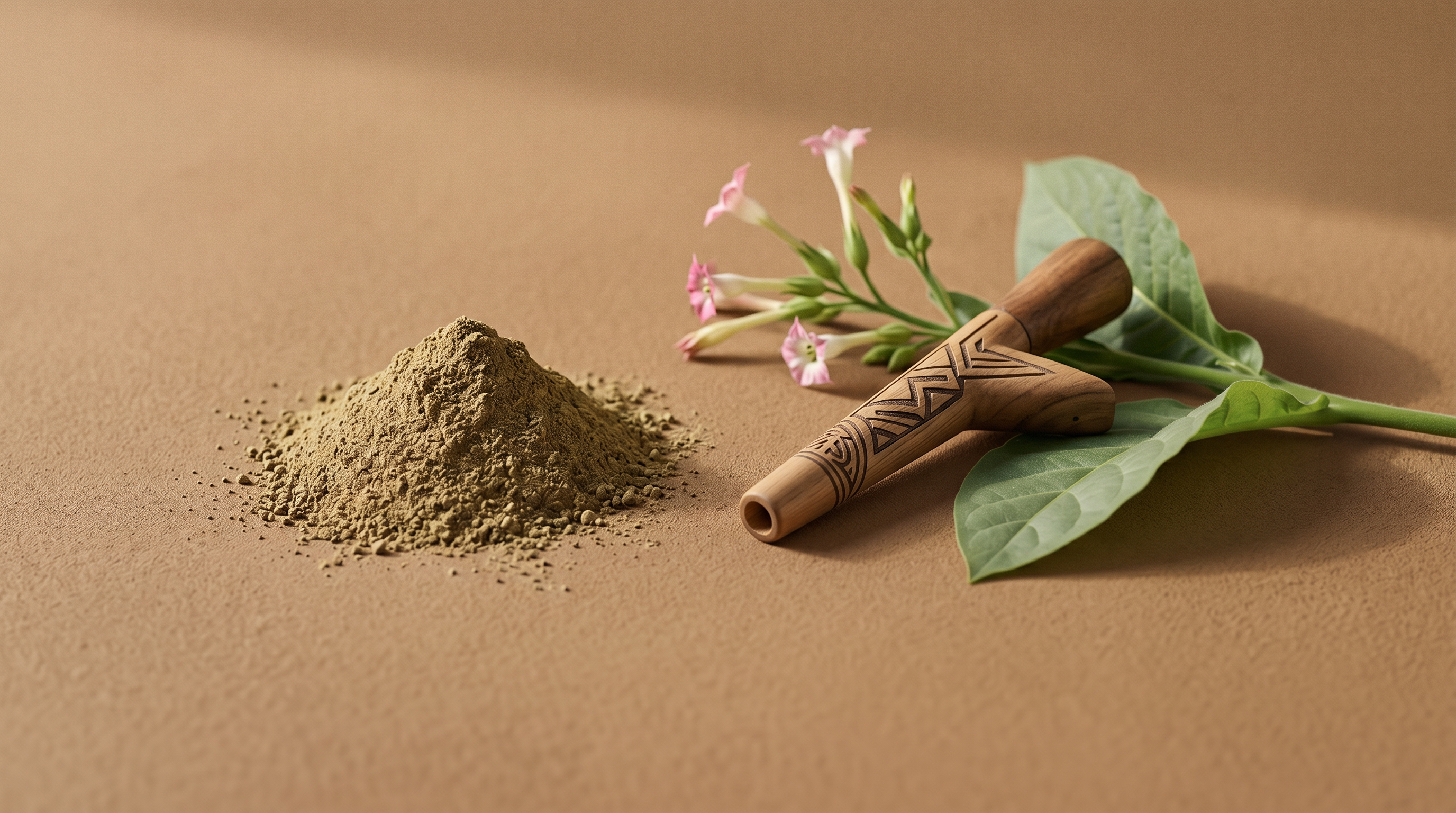
Rapé is not smoked — it is administered as a snuff powder through specially crafted pipes into the nasal passages. There are two traditional tools for use:
- Kuripe — V-shaped pipe for self-administration: one end in the mouth, the other at the nostril
- Tepi — longer, curved pipe for administration by a second person (ceremonial use)
High-quality pieces are handcrafted from wood, bamboo, or bone. The quality and fit of the tool significantly affect the experience.
All details on selection and correct handling in the Tepi & Kuripe article.
First Use: What Beginners Should Know
For people without prior experience, a very cautious start is recommended. Experienced practitioners traditionally speak of small portions — often described figuratively as the size of a grain of rice per nostril. A second portion should only be considered after the first has fully subsided.
Practical guidance for first use:
- Seated, in a quiet environment — no physical activity immediately before or after
- Have water available — nasal discharge and increased saliva are normal reactions
- Ideally with an experienced companion, or at minimum after thorough preparation
- Do not drive or operate machinery in the first 20–30 minutes after use
The effect (5–20 minutes) is typically described by users as an intense moment of pressure followed by mental clarity and grounding — not psychedelic, not visionary.
More on how the effects work in the article Rapé Effects and on user accounts in the article Rapé Experience.
Buying Legally in Germany
Rapé blends made from Nicotiana rustica and tree-ash extracts are legal in Germany — they are listed under neither the Narcotics Act (BtMG) nor the New Psychoactive Substances Act (NpSG). amama sells rapé exclusively for ethnobotanical and ceremonial-cultural use — not as a tobacco product within the meaning of the Tobacco Tax Act, and not as a medicinal product.
Shipping is available within Germany and to the EU — discreet and fast. Please nonetheless observe the country-specific regulations of your country of residence when purchasing from outside your EU member state.
Full details on the legal situation in the article Rapé Legal Status.
Back to the Overview
← Back to the Rapé Guide · Rapé Varieties Compared · Tepi & Kuripe · Rapé Range at amama
Last updated: April 2026. This content is for informational purposes only and does not constitute medical advice. Rapé products from amama are intended for ethnobotanical and ceremonial-cultural use — not a medicinal product, not a tobacco product within the meaning of German tobacco tax law.
Further Reading
→ Nicotine Compound Profile — chemistry & pharmacology