

This article is part of our comprehensive Rapé Guide.
TL;DR
- Tepi is a long pipe for partner-assisted application by a second person — ceremonial, intense, and connecting.
- Kuripe is a short, V-shaped pipe for self-application — suitable for everyday use and personal practice.
- Both tools are available in bamboo, bone, hardwood, or metal — the choice of material carries symbolic significance in indigenous traditions.
- Hygiene is essential: regular cleaning with alcohol, no sharing without thorough disinfection.
- Those new to rapé should start with the kuripe or, for tepi use, under the guidance of an experienced facilitator.
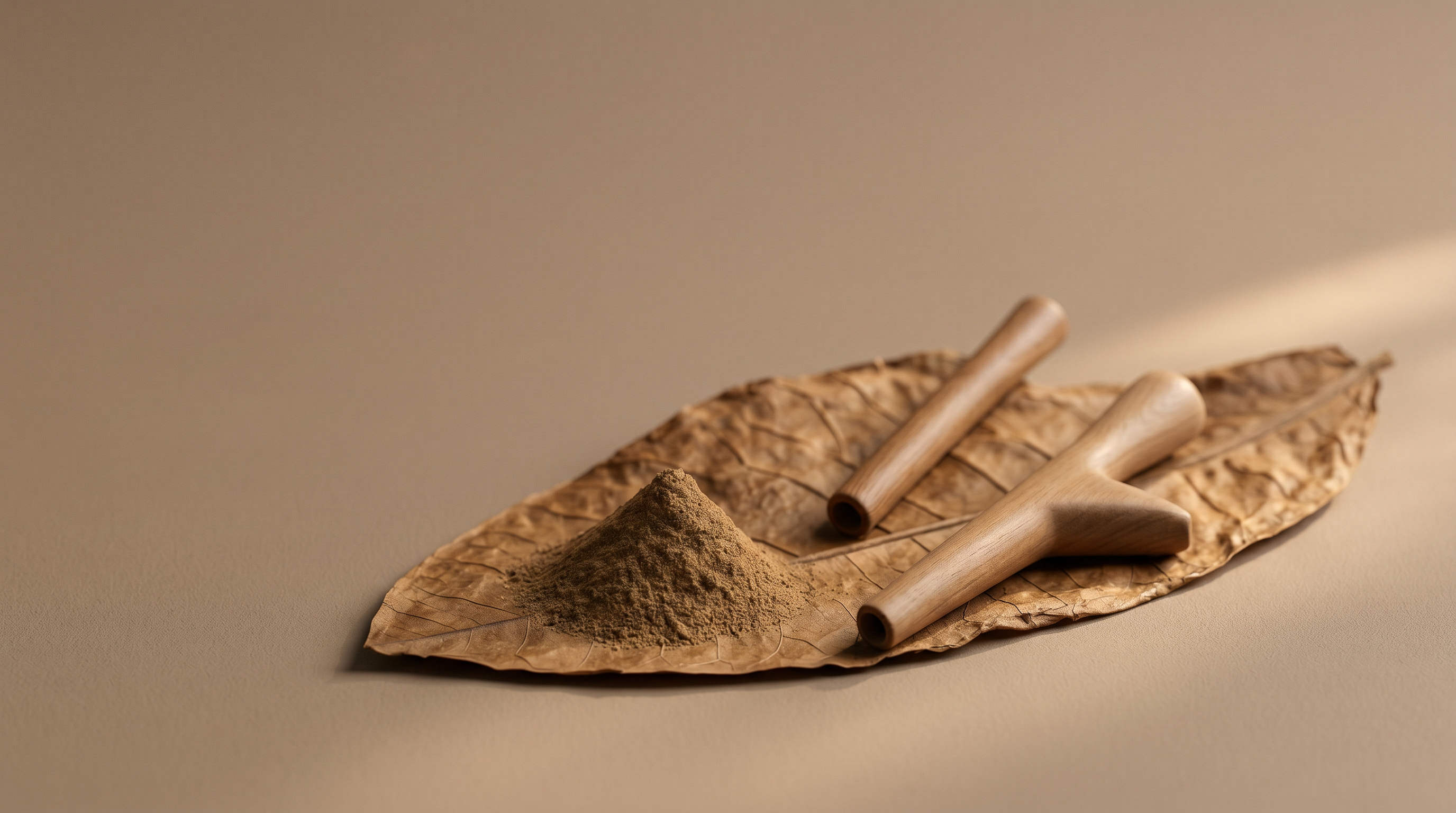
Rapé (pronounced "ha-PÉH") is neither smoked, nor drunk, nor taken orally. The traditional method of application is nasal — and for this purpose, the indigenous peoples of the western Amazon basin have developed specialised tools over generations. Tepi and kuripe are not mere utensils; they are an integral part of ceremonial practice, crafted by hand and, in many communities, imbued with their own spiritual significance.
This article explains how these tools work, what they are made of, how they are cared for — and what it means to use them with intention.
Tepi: The Pipe for Partner-Assisted Application
The tepi is a longer pipe, usually between 15 and 35 cm, straight or slightly curved. One end is placed at the recipient's nostril; into the other end, the person administering — referred to in the tradition as the facilitator or rezador — blows a controlled, forceful breath. This transfers the rapé powder directly into the nasal canal.
In the communities of the Yawanawá, Huni Kuin (Kaxinawá), Kuntanawa, Nukini, and many other peoples of the Brazilian state of Acre as well as neighbouring regions of Peru and Colombia, the tepi is the standard ceremonial form of rapé application. Application by another person carries a symbolic dimension: trust, community, the conscious decision not to face a moment alone. From a practical standpoint, the breath of a second person allows for a more even, often more intense transfer than is possible through self-application.
Materials of the Tepi
- Bamboo: The most classic and most widely used material in indigenous contexts. Lightweight, ecological, and resonant in sound. In the tradition, bamboo is regarded as a material of clarity.
- Bird bone or tapir bone: Preferred in some traditions — very light and naturally smooth. The connection to the animal carries symbolic meaning: the essence of the animal accompanies the user.
- Hardwood (caoba, pau brasil, rosewood, and others): Durable, often beautifully grained and carved. Wooden tepis are frequently tended as personal companions over many years.
- Precious metal (silver, bronze, copper): A more modern variant, particularly common in Western contexts. Easy to clean hygienically, long-lasting — though without a direct connection to indigenous craft traditions.

Nicotiana rustica in flower — the Amazonian "mapacho" tobacco used as the base for traditional rapé.
Wikimedia Commons · CC BY-SA
Kuripe: The Pipe for Self-Application
The kuripe is smaller, V-shaped or L-shaped, typically 5 to 15 cm long. The design allows a single person to hold the mouthpiece with their lips while simultaneously placing the nose piece at the nostril — a single breath is sufficient to transfer the rapé.

nicotine
Traditionally, the kuripe is used for daily personal practice: in preparation for prayer or meditation, between ceremonies, and to maintain inner alignment. It is considered a less ceremonial but more everyday form — a tool of personal responsibility. Users report that self-application requires a different quality of awareness: one is simultaneously the administrator and the recipient, which demands its own form of attention.
The materials largely correspond to those of the tepi — bamboo, wood, bone, metal. Kuripes are often decorated with carvings, threads, or small feathers and are treated as personal objects that are not shared.
Application Technique
With the Tepi (Partner-Assisted Application)
- Preparation: The recipient sits upright, preferably with a straight back. Calm, conscious breathing. The eyes may be closed.
- Loading: The facilitator fills the tepi with a small portion of rapé — one to two small amounts, depending on the intensity that the recipient's level of experience permits.
- Positioning: The recipient exhales gently and then holds the breath quietly. The tepi is placed at the nostril — depending on tradition, beginning with the left side first (the side associated in some traditions with the "lunar" or receptive principle) or the right.
- Application: The facilitator delivers a steady, forceful — but not excessively hard — breath. The powder is transferred into the nasal canal.
- Second side: After a brief moment of silence, the sequence is repeated for the other nostril.
- Afterglow: The recipient breathes calmly, allowing the effects to arise. Physical responses such as tears, the urge to cough, or salivation are normal and should not be suppressed.
With the Kuripe (Self-Application)
- Posture: Sit upright with the spine aligned. A short breathing exercise for centring.
- Loading: A small portion of rapé is placed into the opening of the kuripe.
- Positioning: The nose piece is placed at the nostril and the mouthpiece is taken between the lips.
- Breath: A short, deliberate breath through the mouthpiece — the rapé is transferred into the nostril.
- Pause: A brief moment of silence, then repeat for the other nostril.
- Afterglow: Remain seated upright and integrate the effects. Allow experiences and sensations to be perceived without judgement.
More on the effects and the timeline of the rapé experience: Rapé – Effects
Cleaning and Care
Since tepi and kuripe come into direct contact with mucous membranes, regular hygiene is not optional — it is a fundamental requirement for safe use.
- After each use: Knock the tool dry and run a soft, dry brush or pipe cleaner through it to remove residue.
- Weekly or after each use by another person: Flush the channel with high-proof isopropanol or a neutral high-proof spirit (e.g. vodka, grain spirit) and allow it to dry.
- Never store while wet: Moisture promotes mould growth, particularly in bamboo and wooden tools. Always allow the tepi or kuripe to dry completely before storing.
- Wood care: Wooden tools benefit occasionally from a tiny drop of beeswax or coconut oil worked in with a soft cloth. This protects the wood from drying out and cracking.
- Shared use: Not recommended as a general rule. If a tepi is used ceremonially among multiple people, thorough alcohol decontamination between applications is required.
Choosing: Which Tool Is Right for Me?
| Criterion | Tepi | Kuripe |
|---|---|---|
| Form of application | Partner-assisted (facilitator required) | Independent self-application |
| Ceremonial character | High — trust, community, transmission | Medium — personal practice, self-responsibility |
| Practicality | Requires a second, experienced person | Can be used alone at any time |
| Typical length | 15–35 cm | 5–15 cm |
| Intensity of application | Tends to be more even and more intense | Depends on one's own breath strength |
| Recommendation for beginners | Advisable with an experienced facilitator | Suitable for first independent practice |
Many experienced users own both tools and choose situationally: the tepi for ceremonial contexts or intensive sessions, the kuripe for regular everyday practice.

Choice of Material and the Symbolic Dimension
In the indigenous traditions of the Amazon, the choice of material is not arbitrary. In some communities, bamboo stands for clarity and purity; bone — especially from birds or tapirs — symbolically connects the user to the essence of the animal and its qualities; wood anchors one in the earth. These meanings are context-dependent and derive from the specific cosmological worldviews of the respective peoples.
For users outside these cultures, there is no obligation to adopt this symbolism. Nevertheless, the question — which material speaks to me, which tool do I wish to keep as a companion over time? — can be a meaningful attunement to a conscious practice. A hand-crafted hardwood tepi that one tends and accompanies develops a different quality of relationship than a disposable object.
Common Mistakes in Application
- Too strong a breath: Causes irritation of the nasal mucosa and can be unpleasant to painful. A steady, forceful — not explosive — breath is the target technique.
- Too large a portion: Less is more, especially with little experience. Too large an amount leads to an unnecessarily intense physical reaction. Traditions recommend beginning with care.
- Not sitting upright: A hunched posture affects the flow of breath and can result in the powder not being transferred correctly.
- Neglecting hygiene: Not only a risk of infection, but also disrespectful toward the tool itself — especially when it is used by multiple people.
- No calm setting: Rapé unfolds its effects best in a quiet, stable setting. Used in haste or under emotional stress, the experience can become unpleasant.
Further guidance on safety, contraindications, and the right setting: Rapé Ceremony
Our Rapé Selection at amama

amama carries traditional rapé extract blends from Brazil — including Caneleiro Rapé Extract, Parica Rapé Extract, and Imdurana Rapé Extract — as ethnobotanical collectibles for certified connoisseurs. All blends are based on Nicotiana rustica (Mapacho) and ceremonial tree ash combinations as used in the traditions of the Yawanawá, Huni Kuin, and related peoples.

Further Articles
Back to the Rapé Guide · Rapé Ceremony · Rapé Varieties · Rapé Effects · Buy Rapé
Last updated: April 2026. This content is for informational purposes only and does not constitute medical advice.
Further Reading
→ Nicotine Compound Profile — chemistry & pharmacology